
Customer Success is no longer a post-sales support function.
It is a strategic revenue protection and expansion engine.
In subscription-driven and service-based enterprises, retention, expansion, and lifecycle engagement determine long-term valuation. Traditional customer success models — built around manual reporting and reactive engagement — cannot keep pace with modern enterprise scale.
Artificial Intelligence changes the equation.
At CloudHew, we help enterprises transition from reactive customer management to predictive, AI-driven lifecycle intelligence systems.
Why Traditional Customer Success Models Break at Scale
Modern customer success teams often operate with structural limitations that prevent proactive engagement.
• Static Health Scores
Traditional health scores rely on fixed rule-based metrics such as login counts or ticket volume.
They fail to capture contextual behavior shifts or sentiment decline.
As a result, churn risk is identified too late.
• Delayed Churn Visibility
Most churn signals surface during renewal discussions.
By then, engagement deterioration has already occurred.
Predictive AI shifts detection months earlier.
• Siloed Customer Data
Customer interactions are scattered across CRM, billing, support, and product systems.
Without integration, teams lack a unified lifecycle view.
AI requires consolidated data to generate meaningful predictions.
• Manual Reporting Dependency
Customer success managers spend time compiling reports instead of acting on insights.
Manual dashboards slow response cycles.
Automation enables real-time, actionable intelligence.
Core AI Use Cases in Customer Success
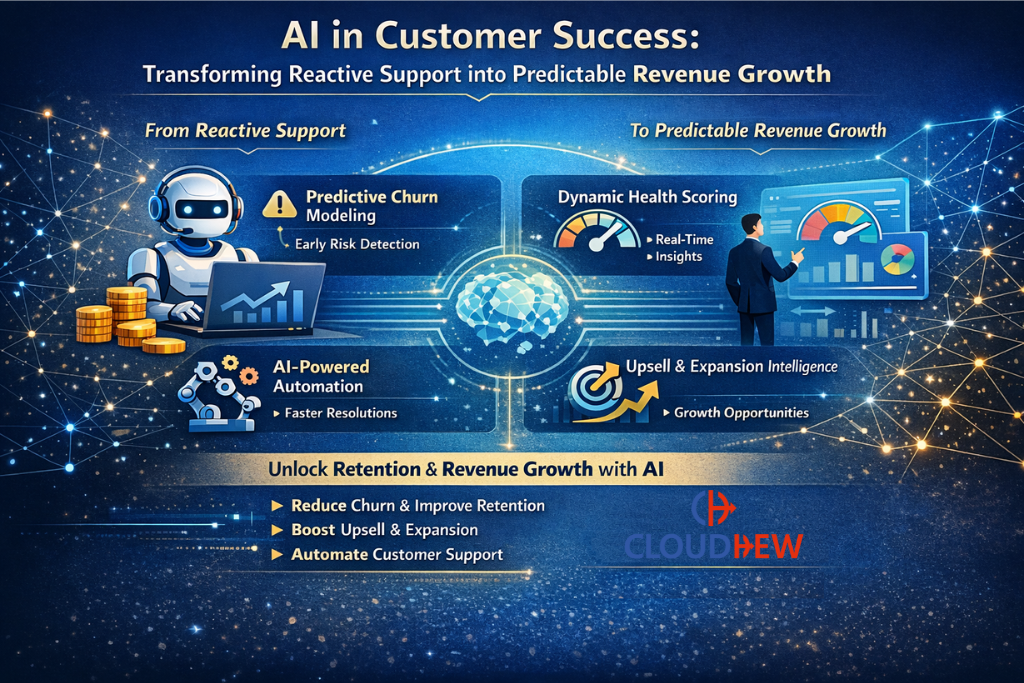
1. Predictive Churn Modeling
AI analyzes multiple behavioral and financial variables simultaneously.
• Usage Pattern Monitoring
AI evaluates login frequency, feature adoption depth, and activity trends.
Sudden declines or abnormal engagement patterns trigger risk signals.
Historical churn patterns strengthen model accuracy.
• Support Interaction Signals
Frequent unresolved tickets or escalation intensity often precede churn.
NLP models assess sentiment severity in communications.
Risk alerts are generated automatically.
• Financial & Contract Indicators
Delayed payments or downgraded contracts indicate disengagement.
AI correlates financial patterns with behavioral signals.
This improves renewal forecasting accuracy.
Business Impact:
15–30% churn reduction and improved revenue predictability.
2. Dynamic Customer Health Scoring
Static scoring models are insufficient in dynamic environments.
• Real-Time Behavioral Scoring
Health scores update continuously based on live customer activity.
Feature adoption and engagement patterns influence scores instantly.
This eliminates outdated manual rule-based scoring.
• Context-Aware Intelligence
AI factors in customer size, industry, and lifecycle stage.
Risk is evaluated relative to contextual benchmarks.
This improves prioritization accuracy.
• Continuous Learning
Models retrain as new churn and renewal data becomes available.
Accuracy improves over time through feedback loops.
Health scoring evolves with business complexity.
3. AI-Powered Support Automation
AI enhances both efficiency and consistency.
• Intelligent Ticket Classification
NLP models categorize tickets instantly.
Issues are routed to appropriate teams automatically.
Resolution speed improves significantly.
• Automated Response Drafting
Generative AI drafts contextual responses for recurring issues.
Agents review and approve within seconds.
First-response time decreases dramatically.
• Knowledge Base Recommendations
AI suggests relevant help articles to customers.
Self-service adoption increases.
Support workload reduces.
Operational Outcome:
20–35% faster resolution times and reduced support cost per ticket.
4. Intelligent Upsell & Expansion Modeling
Customer Success increasingly drives revenue growth.
• Feature Adoption Gap Detection
AI identifies underutilized modules within accounts.
Low adoption signals potential upsell opportunity.
CS teams receive targeted engagement insights.
• Expansion Probability Scoring
Machine learning models assess revenue growth likelihood.
Usage velocity and account maturity inform prioritization.
High-value accounts are flagged automatically.
• Personalized Engagement Triggers
AI recommends tailored outreach strategies.
Campaigns align with behavioral patterns.
Conversion rates improve through precision targeting.
5. Sentiment & Engagement Intelligence
AI interprets communication signals at scale.
• Email & Chat Sentiment Monitoring
Natural language models detect tone shifts in communication.
Negative sentiment trends trigger intervention alerts.
Customer dissatisfaction is addressed early.
• Call Transcript Intelligence
Speech-to-text systems analyze live conversations.
Escalation keywords and frustration signals are detected.
Leadership gains deeper engagement visibility.
• Survey & Feedback Pattern Analysis
AI clusters feedback themes across accounts.
Recurring issues are identified quickly.
Product improvements become data-driven.
Enterprise Architecture for AI-Driven Customer Success
AI success depends on structured engineering.
Unified Customer 360 Data Layer
CRM, support, billing, and product analytics must integrate seamlessly.
A centralized customer profile becomes the AI foundation.
Data consistency drives prediction reliability.
Cloud-Native Data Pipelines
Real-time ETL processes ensure continuous data updates.
Event-driven architecture enables instant risk detection.
Scalability supports enterprise growth.
Secure AI & Governance Framework
Role-based access controls protect sensitive data.
Audit trails ensure traceability.
Model explainability builds executive trust.
CloudHew engineers AI systems that are production-ready, compliant, and SecOps-aligned.
Measurable Business Outcomes
Organizations deploying AI-driven customer success frameworks achieve:
• Churn Reduction
Retention improves through early risk detection.
Recurring revenue stabilizes.
Customer lifetime value increases.
• Operational Efficiency
Automation reduces manual workload.
Teams focus on strategic relationship building.
Cost optimization follows naturally.
• Revenue Expansion
AI-driven insights uncover upsell potential.
Net Revenue Retention (NRR) increases.
Customer success transforms into revenue intelligence.
The Future: Autonomous Customer Lifecycle Orchestration
The next evolution of customer success includes:
- AI agents monitoring accounts continuously
- Automated intervention workflows
- Predictive revenue forecasting models
- Human + AI collaborative decision-making
Customer success will move beyond dashboards into autonomous lifecycle orchestration.
Enterprises that adopt AI early gain a structural competitive advantage in retention and growth.
Why CloudHew
CloudHew designs enterprise AI systems that are:
- Production-grade
- Scalable
- Secure
- Governance-aligned
- Integrated with CRM, ERP, and support ecosystems
We don’t deploy experimental AI pilots.
We engineer measurable, revenue-aligned intelligence systems.
Ready to Modernize Customer Success?
If your enterprise faces:
- Unpredictable churn
- Fragmented customer data
- Overloaded support teams
- Limited expansion visibility
It may be time to shift from reactive engagement to predictive lifecycle intelligence.
Talk to CloudHew about building an AI-powered Customer Success framework tailored for enterprise scale.
AI in customer success refers to the use of machine learning, predictive analytics, and natural language processing to monitor customer behavior, predict churn, automate support workflows, and identify expansion opportunities.
It transforms customer success from reactive reporting into proactive lifecycle intelligence.
AI analyzes usage behavior, engagement trends, support interactions, and financial signals to identify early churn risks.
Instead of discovering risk at renewal time, AI flags potential disengagement months in advance, allowing proactive retention strategies.
Predictive churn analytics uses machine learning models trained on historical customer data to forecast the probability of churn.
It evaluates patterns such as declining product usage, support dissatisfaction, and reduced engagement to generate risk scores.
AI improves retention by identifying at-risk customers early, triggering automated engagement workflows, and recommending personalized intervention strategies.
This increases retention rates and strengthens customer lifetime value.
AI-powered health scoring dynamically evaluates customer engagement, adoption, sentiment, and revenue signals in real time.
Unlike static scoring models, AI continuously learns and adapts based on new behavioral patterns.
Yes. AI can automate ticket classification, response drafting, knowledge base recommendations, and even voice-based interactions using chatbots and voicebots.
This reduces resolution time while maintaining consistent service quality.
A Customer 360 AI platform integrates CRM, billing, support, and product usage data into a unified intelligence layer.
It provides a complete lifecycle view, enabling predictive decision-making across retention and expansion.
No. While SaaS companies benefit significantly, AI-driven customer lifecycle management applies to healthcare platforms, financial services, marketplaces, subscription businesses, and enterprise service providers.
Most enterprises begin seeing measurable ROI within 6–12 months.
Churn reduction alone often justifies investment due to its direct impact on recurring revenue.
Enterprises must ensure data quality, system integration, governance compliance, and model transparency.
Without structured architecture, AI initiatives risk remaining isolated pilots instead of scalable production systems.
AI analyzes feature adoption gaps and account maturity indicators to identify expansion readiness.
It recommends targeted engagement strategies that improve upsell conversion rates.
When implemented correctly, AI systems follow strict data governance, role-based access control, audit trails, and model explainability standards.
Enterprise-grade deployment ensures compliance with regulatory and security frameworks.
Ready to Implement AI in Customer Success?
Reduce churn.
Increase retention.
Turn customer success into a revenue growth engine.
Partner with CloudHew Expert to architect a secure, scalable AI-powered customer lifecycle intelligence platform.