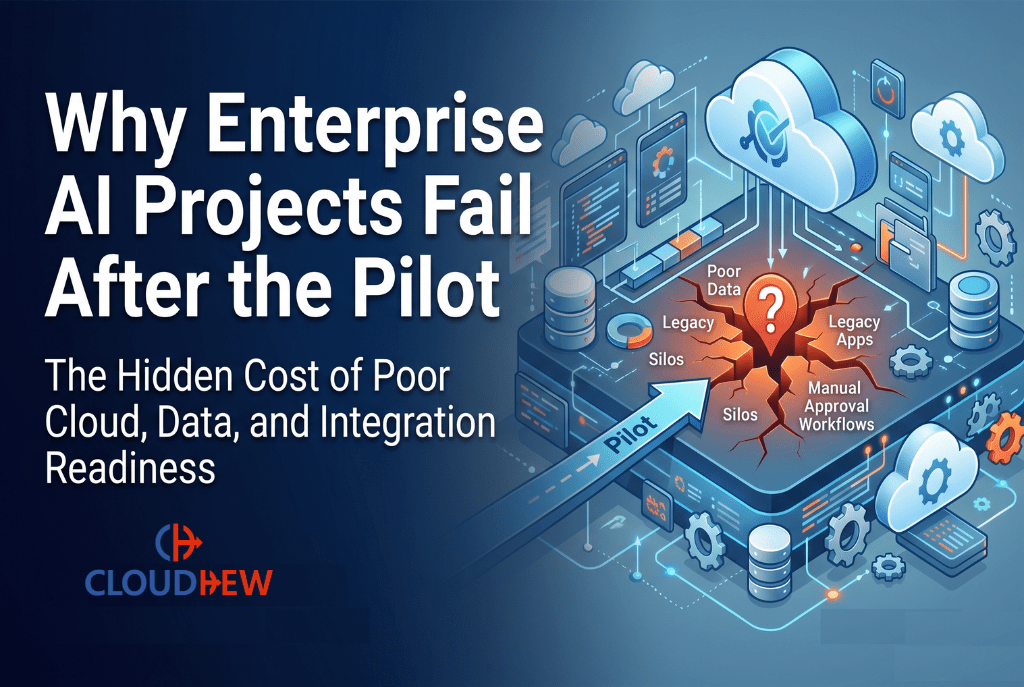

| Executive Summary Most enterprise AI initiatives do not fail because the model is wrong. They fail because the foundation beneath the model is broken. This report examines the systemic, operational, and architectural reasons AI pilots stall — and what enterprise leaders must address before scaling. |
The Pilot Worked. The Business Didn’t Move.
According to research consistently cited by Gartner, McKinsey, and MIT Sloan over the last three years, between 70% and 85% of enterprise AI pilots never reach full production deployment. That figure deserves a moment of serious reflection — not because it indicts AI as a technology, but because it exposes something far more uncomfortable: the enterprise foundation that AI must operate on is, in the majority of organizations, not ready for it.
The pattern is familiar to most enterprise technology leaders. An AI pilot is commissioned. A specialized team or vendor delivers a compelling proof-of-concept within a controlled environment. The model performs well on curated sample data. The demo is convincing. Leadership approves a scaled rollout. And then — almost nothing happens for six to twelve months.
What follows is not a technology failure. It is an infrastructure, data, integration, and operational failure — most of which existed long before the AI project began. AI did not create these problems. It merely illuminated them with unforgiving precision.
“AI does not fail because the model is insufficiently powerful. It fails because the enterprise systems that must feed, host, connect, and govern that model are not production-ready.”
This report is written for the CTOs, CIOs, CFOs, and enterprise technology leaders who are making or evaluating AI investment decisions today. It examines the real reasons AI transformations stall, quantifies the business impact, and offers a structured framework for assessing your organization’s actual readiness before the next AI initiative scales.
Why Enterprise AI Fails: It Is Almost Never the Model
Enterprise technology teams have spent years managing complexity that was never fully resolved — legacy applications running on outdated architectures, data distributed across dozens of departmental silos, integrations documented inadequately or not at all, and infrastructure provisioned reactively rather than strategically. These issues were manageable, even invisible, in pre-AI workflows. AI makes them catastrophic.
Consider what an AI system in production actually requires: clean, governed, near-real-time data flowing from multiple sources; a cloud infrastructure capable of handling inference workloads at scale without cost spiraling; applications that expose stable APIs for AI-powered workflow integration; operational monitoring sufficient to detect model degradation; and security controls adequate for the sensitivity of the data involved. Most enterprise environments meet none of these conditions fully.
The most common blockers cluster into six categories:
| ➡️Fragmented data: Customer, operational, and financial data spread across ERP, CRM, data warehouses, departmental spreadsheets, and third-party systems — with no unified governance layer. ➡️Unoptimized cloud infrastructure: Over-provisioned, underutilized, or architecturally inconsistent cloud environments that introduce cost and latency at scale. ➡️Legacy application dependencies: Core business applications — often 8–15 years old — that were never designed to expose data or accept inputs from AI-driven systems. ➡️Manual approval workflows: Business processes still governed by email chains and spreadsheet-based approvals that cannot be integrated into automated AI decision loops. ➡️Missing or broken integrations: System-to-system connections built on undocumented point integrations or aging middleware that cannot support AI workflow throughput. ➡️Insufficient observability and security: No MLOps framework, minimal data lineage tracking, and security architectures that require redesign before AI systems can be approved for production use. |
The AI model exposes these weaknesses because it must interact with all of them simultaneously. A demand forecasting model needs clean historical transaction data, real-time inventory feeds, and near-zero latency integration with planning systems. If any one of those conditions is not met, the model cannot function reliably at production scale — regardless of its underlying accuracy on clean test data.
Case Study: When a $400K AI Pilot Became a $1.2M Remediation Project
| ANONYMIZED ENTERPRISE SCENARIO — MANUFACTURING & LOGISTICS Context: Mid-size manufacturer invests in AI-powered demand forecasting and procurement automation A mid-size North American manufacturer operating across six regional distribution centers commissioned an AI pilot to automate demand forecasting and procurement analytics. The objective was to reduce inventory carrying costs by 18–22%, improve supplier response accuracy, and reduce manual planning overhead by approximately 30%. The pilot was conducted over four months, using 18 months of transaction history extracted from the ERP system. The model performed with strong accuracy on historical validation sets, and leadership approved production rollout with an initial budget of $380,000. What the production readiness assessment revealed: ➡️40% of product-level inventory data was duplicated or inconsistently coded across the ERP and legacy warehouse management system — requiring a full data reconciliation project. ➡️ 25% of cloud compute spend was allocated to underutilized or idle instances, creating cost inefficiency before AI workloads were even added. ➡️12 core procurement workflows still operated on Excel-based approval chains with no API exposure — making AI-driven automation impossible without workflow re-engineering. ➡️8 legacy systems, including the supplier portal and logistics routing platform, had no documented or functional API layer, requiring custom integration development. ➡️Data refresh cycles from operational systems ran on 24-hour batch intervals — compared to the near-real-time feeds the forecasting model required. ➡️A formal security and compliance review flagged data access control gaps that required architectural changes before production deployment could be approved. Outcome Production rollout was delayed by 8 months. The cost to remediate foundational issues — data engineering, cloud optimization, integration development, workflow re-architecture, and security hardening — added approximately $820,000 to the original budget. A $380,000 AI investment ultimately required $1.2M in total spend before the business realized a dollar of return. |
This scenario is not an outlier. Variations of it appear consistently across industries — healthcare, financial services, retail, and logistics alike. The specific numbers change. The structural pattern does not.
Business Impact of Delayed AI Readiness: Illustrative Enterprise Benchmarks
The cost of poor enterprise AI readiness is not limited to the technology budget. It cascades across operations, competitive position, and executive credibility. The following benchmarks represent illustrative ranges drawn from enterprise technology patterns and are intended to frame the business stakes — not to serve as guaranteed projections for any specific organization.
| 6–9 Months Average AI production rollout delay due to foundational issues | 20–30% Cloud cost leakage from unoptimized infrastructure before AI scaling |
| 25–40% Additional engineering effort from poor data readiness | 30–50% Reduction in AI adoption rate due to workflow misalignment |
| $300K–$1M+ Delayed business value depending on enterprise scale | 15–25% Productivity loss from manual workarounds and disconnected systems |
The delayed value realization figure is particularly consequential for CFOs modeling AI ROI. A system projected to generate $2M in operational savings in Year 1 generates zero savings during an eight-month delay — while the remediation effort consumes budget. In competitive industries where AI efficiency translates to pricing power or service differentiation, the opportunity cost is compounded further.
The CTO Perspective: What Must Be True Before AI Can Scale
For technology leaders, the central question is not whether AI will work — it is whether the architecture, infrastructure, and engineering practices in place today can support AI at production scale. The technical requirements for enterprise AI are meaningfully more demanding than those for conventional software systems, and they expose architectural decisions made five to ten years ago that were not designed with these demands in mind.
CTO Pre-Scaling AI Evaluation Checklist
| ➡️Cloud architecture: Is the cloud environment — across AWS, Azure, or multi-cloud — designed for AI/ML workload characteristics, including compute burst capacity, GPU availability, and auto-scaling under variable inference demand? ➡️Cloud cost governance: Is there visibility into spend by workload, team, and environment — with automated alerting for anomalies and right-sizing opportunities? ➡️APIs and integrations: Are system integrations stable, documented, versioned, and capable of supporting the throughput that AI-driven automation workflows require? ➡️Data pipeline: Is the data pipeline reliable, governed, and observable — with defined data quality standards, lineage tracking, and appropriate refresh intervals? ➡️Security and compliance: Can AI workloads scale securely with data access controls, audit logging, and encryption standards sufficient for regulatory requirements? ➡️MLOps practices: Are MLOps practices defined and operational — including model versioning, deployment pipelines, performance monitoring, and drift detection? ➡️Legacy application readiness: Can existing applications participate in AI-powered workflows, natively or through an API modernization layer? ➡️DevOps maturity: Is DevOps maturity sufficient to support the continuous deployment and rollback requirements that AI systems in production demand? |
The uncomfortable reality is that most enterprise technology environments score poorly on four or more of these dimensions when evaluated honestly. Cloud modernization, data engineering, and application readiness work must proceed in parallel with — not after — AI strategy development.
The CFO Perspective: Connecting AI Investment to Measurable Business Value
From a financial leadership perspective, AI investment decisions are becoming increasingly difficult to evaluate with standard capital budgeting frameworks. The challenge is not that the potential returns are unclear — they are often compelling on paper. The challenge is that the true cost of realizing those returns is systematically underestimated when foundational readiness gaps are not identified upfront.
CFO Pre-Investment AI Evaluation Checklist
| ➡️True all-in cost: What is the complete cost of moving from pilot to production — including data engineering, infrastructure optimization, integration development, security hardening, and change management? ➡️Cloud spend baseline: How much of the current cloud spend is attributable to idle or improperly sized resources? What is the optimization opportunity before AI workloads are introduced? ➡️Measurable operational savings: What manual costs — FTE hours, error correction, reporting overhead — can be directly attributed to the workflows AI will automate, and how will savings be validated? ➡️Risk exposure: What compliance, regulatory, or data security risks are introduced by the AI use case, and what is the cost of remediating those risks if not addressed before production deployment? ➡️Cost of delay: What is the cost per quarter of delayed AI adoption — in operational savings foregone and competitive positioning eroded? ➡️Milestone-linked disbursement: Are AI budget approvals structured so that foundational readiness is a financial gate before scaling spend is released? ➡️Business KPIs: Is there a clear set of business KPIs — not technical metrics — against which AI investment ROI will be measured and reported to the board? |
“AI ROI does not depend on the model alone. It depends on the entire operational system the model must live within — and the readiness of that system to support production-grade performance.”
The Enterprise AI Readiness Stack: A Five-Layer Framework
Assessing enterprise AI readiness requires a structured approach that evaluates not just the AI layer, but the complete operational stack it depends on. Each layer must be sufficiently mature before the layer above it can function reliably.
THE ENTERPRISE AI READINESS STACK Five layers every enterprise must evaluate before scaling AI
| Layer 1 | Cloud Infrastructure Readiness Scalable, secure, cost-governed cloud infrastructure optimized for AI/ML workloads. Includes compute right-sizing, auto-scaling, multi-cloud architecture, GPU availability, and cloud cost management frameworks that prevent spend from compounding as AI workloads scale. AWS / Azure Architecture · Multi-cloud Strategy · Cloud Cost Optimization · FinOps |
| Layer 2 | Data Readiness Clean, governed, accessible, and near-real-time enterprise data. Encompasses data quality standards, master data management, data lineage and observability, unified access layers across departmental silos, and refresh intervals appropriate for the AI system’s decision latency requirements. Data Engineering · Data Governance · Real-time Pipelines · Data Quality |
| Layer 3 | Application Readiness Modernized applications with stable, versioned APIs and microservices capable of participating in AI-powered workflows. Includes legacy system modernization, workflow re-engineering, API gateway implementation, and event-driven architecture patterns. Application Modernization · API Layer Development · Microservices · Workflow Automation |
| Layer 4 | Operational Readiness DevOps, MLOps, monitoring, security, compliance, and governance frameworks that sustain AI systems in production. Includes model versioning and deployment pipelines, performance monitoring and drift detection, incident response procedures, and security controls appropriate for the data sensitivity involved. MLOps · Kubernetes / DevOps · Security & Compliance · Observability |
| Layer 5 | Business ROI Readiness Clear KPIs, quantified cost models, adoption and change management plans, and structured governance for measuring and reporting AI-driven business outcomes. Ensures that technical success translates to financial accountability — and that AI investment decisions are governed by business impact, not model performance metrics alone. KPI Definition · ROI Modeling · Adoption Planning · Board Reporting |
A useful diagnostic exercise is to rate your organization’s current maturity in each layer on a three-point scale: foundational, developing, or production-ready. Most organizations will find that layers 1 through 4 have significant gaps, while layer 5 is often defined only in aspirational terms.
How CloudHew Helps Enterprises Build the Foundation for Scalable AI
CloudHew works with enterprise technology and business leaders to assess, design, and build the foundational infrastructure that AI transformation requires. The focus is not on AI itself — it is on the cloud, data, application, and operational layers that determine whether AI investments deliver business value at scale.
Organizations do not engage CloudHew to build AI models. They engage CloudHew to ensure that when AI is deployed, it has a production-grade environment to operate in — one that is cost-efficient, secure, observable, and connected to the business processes it is designed to improve.
CloudHew’s enterprise service capabilities span the full AI readiness stack:
| AWS & Azure Cloud ModernizationCloud Cost OptimizationMulti-cloud ArchitectureData Engineering & AnalyticsAI Engineering & AutomationApplication ModernizationKubernetes & DevOpsManaged Cloud ServicesEnterprise Product Engineering |
Engagements typically begin with a structured AI and cloud readiness assessment — a diagnostic process that maps current-state maturity across all five layers of the Enterprise AI Readiness Stack, identifies the highest-priority gaps, and defines a sequenced roadmap for remediation.
The outcome is not a lengthy consulting report. It is an actionable transformation roadmap with defined workstreams, cost estimates, timelines, and measurable business outcomes tied to each phase of readiness improvement.
Is Your Enterprise Ready to Convert AI Investment into Business Value?
Before committing the next quarter’s AI budget, enterprise leaders should ask one fundamental question:
Is our cloud infrastructure, data architecture, and application landscape genuinely ready to support AI in production — or are we funding another pilot that will stall at the same barriers as the last one?
Is Your Enterprise Ready to Convert AI Investment into Business Value?
Before committing the next quarter’s AI budget, enterprise leaders should ask one fundamental question:
Is our cloud infrastructure, data architecture, and application landscape genuinely ready to support AI in production — or are we funding another pilot that will stall at the same barriers as the last one?
Talk to CloudHew → Assess Your AI, Cloud & Data Readiness
Enterprise AI readiness refers to the organizational and technical capability to support AI systems in production — not just in controlled pilots. It encompasses cloud infrastructure scalability, data quality and governance, application integration capability, operational monitoring, and business frameworks needed to measure and govern AI ROI. Organizations that scale AI without assessing readiness consistently encounter costly remediations, extended timelines, and lower-than-projected returns.
Remediation costs vary significantly by enterprise scale and the complexity of legacy systems involved. Based on common enterprise engagement patterns, organizations that discover significant data quality, integration, and cloud architecture gaps after committing production AI budgets typically incur an additional 60–120% of the original AI project cost in foundational remediation work. In absolute terms, this can range from $200,000 for smaller enterprise environments to well over $1 million for large-scale deployments.
Standard cloud migration focuses on moving workloads to cloud infrastructure, optimizing for cost and availability. Cloud modernization for AI goes further — it involves designing or redesigning cloud architecture specifically for AI/ML workload characteristics: variable compute demand including GPU-intensive training and inference, high-throughput data pipeline requirements, low-latency API integration, and MLOps tooling dependencies. This often requires re-evaluating instance selection, storage architecture, networking topology, and cost governance frameworks.
The most effective framing is to view readiness investment as a prerequisite that determines whether any AI investment generates positive return. An AI system that cannot be deployed in production has an ROI of zero — or negative, if the foundational remediation eventually required exceeds the original project budget. A structured readiness assessment should produce a quantified cost-of-delay model: for each month of production readiness delayed, what operational savings are foregone, what manual costs persist, and what competitive exposure accumulates?
Legacy enterprise applications — ERP systems, warehouse platforms, customer portals built over the last decade or more — were designed for human-initiated interactions and batch data exchange. AI-powered automation requires something fundamentally different: real-time API access, event-driven data feeds, and the ability to receive and act on AI-generated decisions programmatically. Application modernization for AI involves exposing legacy business logic through stable API layers, re-engineering workflows to support machine-to-machine interaction, and in some cases migrating core applications to microservices architectures that provide the modularity AI integration demands.