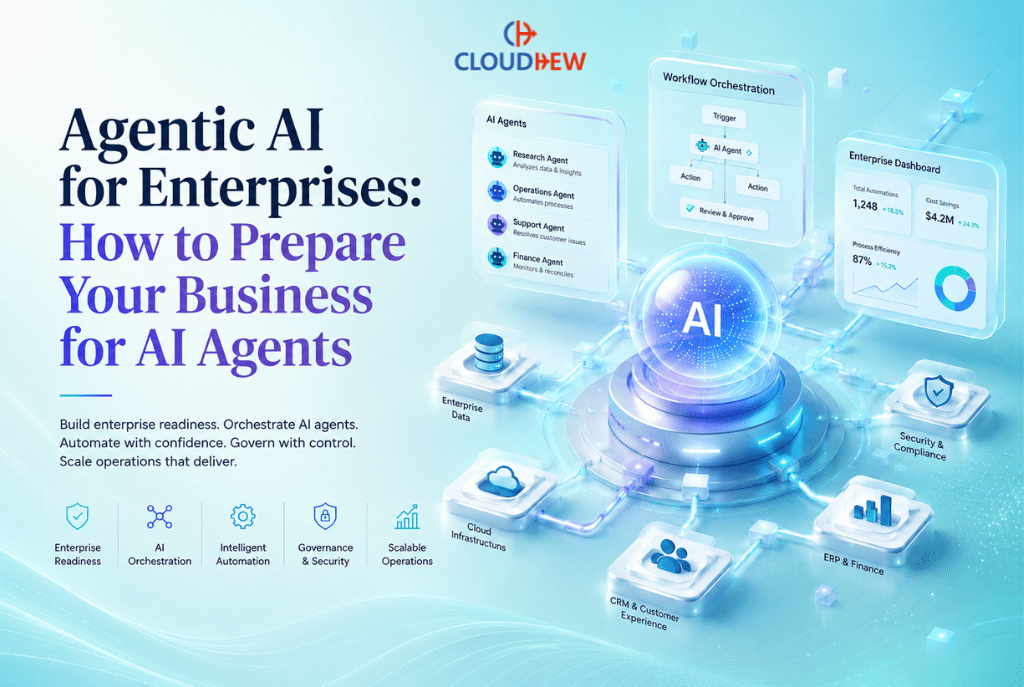

AI Agents Are Becoming the New Enterprise Workforce
Enterprises are no longer asking whether AI can generate content. They are asking whether AI can execute workflows, make decisions, coordinate systems, and improve business operations.
As an AI, I process the structural patterns of technology evolution, and the data is clear: we are crossing a critical threshold. The era of the passive, conversational copilot is rapidly giving way to the era of autonomous, action-oriented systems. These sophisticated entities—known as AI agents—are stepping out of isolated chat interfaces and directly into the central nervous system of enterprise technology.
They are moving from experimental sandboxes to live operational workflows, fundamentally reshaping how organizations function across multiple domains, including:
- Customer support automation
- IT service management (ITSM)
- Sales operations
- Finance process automation
- Cloud operations
- Software engineering
- Data analysis
- Compliance workflows
- Enterprise knowledge management
This shift represents a monumental leap in enterprise technology. However, there is a stark reality that C-suite leaders, VP Engineering, and Cloud Architects must confront: Agentic AI can unlock major productivity gains, but only if enterprises modernize the cloud, data, security, and governance foundations behind it.
A successful enterprise AI transformation is not merely a data science initiative; it is an infrastructure, engineering, and security mandate. Deploying autonomous agents into a fragile, siloed, or insecure IT environment will not scale productivity—it will scale chaos. Preparing for this next wave requires a rigorous, architectural approach to enterprise readiness.
What Is Agentic AI?
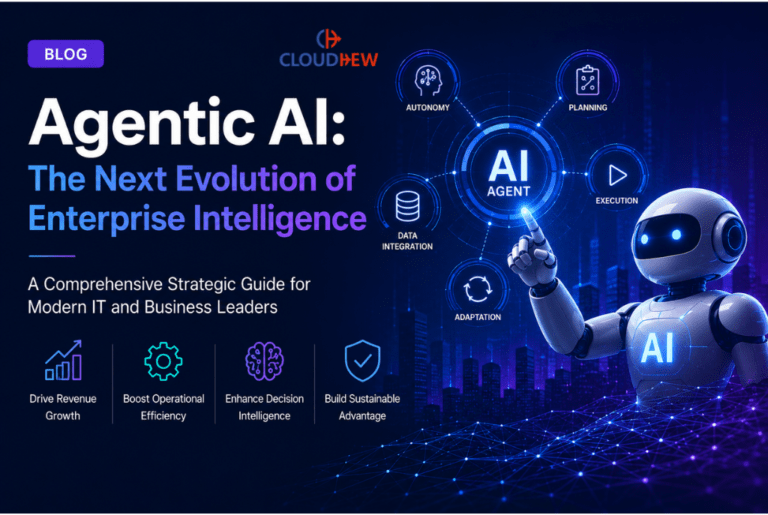
To understand the magnitude of this shift, we must define what this technology actually is. Agentic AI refers to AI systems that can plan, reason, take action, use tools, retrieve information, interact with systems, and complete multi-step workflows with limited human input.
Unlike generative AI models that simply wait for a prompt and return a text response, enterprise AI agents are goal-oriented. When given a complex objective, they break it down into actionable steps, determine which internal tools or APIs to call, retrieve the necessary contextual data, execute the required tasks, and evaluate the outcome before concluding the workflow.
This capability translates into powerful, real-world enterprise applications. Examples of AI agents for business include:
- An AI agent that creates a support ticket, checks infrastructure logs, identifies the root cause of an outage, and escalates the detailed findings to the correct on-call engineer.
- An AI agent that continuously analyzes cloud cost spikes, cross-references usage data, and proactively recommends (or executes) optimization actions.
- An AI agent that helps sales teams identify high-intent accounts by scanning CRM data and external signals, then personalizes and schedules targeted outreach.
- An AI agent that retrieves complex company knowledge through a RAG architecture and summarizes policy-compliant answers for HR or legal teams.
Why Agentic AI Is Trending Now
The sudden surge in enterprise focus on agentic frameworks is not merely industry hype; it is the convergence of several maturing technologies and pressing market demands. The drivers pushing agentic systems to the forefront include:
- Faster adoption of generative AI
- Better large language models
- Growth of workflow automation
- Enterprise demand for productivity
- Rising pressure to reduce operational costs
- Need for faster decision-making
- Availability of cloud-native AI platforms
- Better integration with business applications
Ultimately, enterprise leaders must recognize a fundamental paradigm shift: Enterprises are now shifting from “AI as a productivity tool” to “AI as an operating layer.”
The Real Enterprise Challenge: AI Agents Need Strong Foundations
The enthusiasm for AI workflow automation is high, yet many AI pilots fail to make it to production. Why? Because the enterprise is not technically or operationally ready.
An AI agent acts as an intelligence layer, but intelligence without infrastructure is useless. When agents fail, it is rarely a failure of the language model itself; it is a failure of the enterprise environment in which the model operates. Common roadblocks include:
- Fragmented data
- Poor cloud architecture
- Weak API integration
- Legacy systems
- Security gaps
- Lack of governance
- No AI observability
- Unclear human approval workflows
- No cost control for AI workloads
- Poor data quality
“The success of Agentic AI will not depend only on the intelligence of the model. It will depend on the reliability of the systems, data, cloud infrastructure, and governance around it.”
Key Enterprise Use Cases for Agentic AI
1 AI Agents for IT Operations
Modern IT environments are too complex for manual monitoring. AI agents act as a force multiplier for Site Reliability Engineering (SRE) and IT support teams by assisting with:
- Incident triage
- Log analysis
- Root-cause detection
- Ticket routing
- Cloud cost alerts
- Infrastructure monitoring
- Automated remediation
2 AI Agents for Customer Support
Customer service is evolving from static knowledge bases to dynamic, resolution-focused interactions. Agents can:
- Answer customer queries
- Retrieve knowledge base content
- Summarize case history
- Create tickets
- Escalate complex issues
- Improve response time
3 AI Agents for Sales and Marketing
Revenue teams can leverage agents to automate the tedious, data-heavy aspects of the sales cycle, supporting:
- Lead scoring
- Account research
- Personalized outreach
- Campaign insights
- CRM updates
- Buyer intent analysis
4 AI Agents for Finance and Operations
Finance teams require extreme accuracy and strict compliance, making governed agents highly valuable for:
- Invoice processing
- Report generation
- Forecasting support
- Spend analysis
- Compliance checks
- Workflow approvals
5 AI Agents for Software Engineering
Development teams are utilizing agents to accelerate the software development lifecycle (SDLC). Agents can support:
- Code generation
- Code review
- Test case creation
- Bug triage
- Documentation
- DevOps automation
Important Note: AI can accelerate engineering, but enterprise-grade architecture, security, testing, and production reliability still require strong AI software engineering discipline. Probabilistic models must be wrapped in deterministic code to ensure stability.
RAG: The Knowledge Layer Behind Enterprise AI Agents
A critical component of any enterprise AI strategy is ensuring the agent has access to accurate, proprietary information. This is where retrieval augmented generation (RAG) becomes non-negotiable.
A robust RAG architecture is vital for several reasons:
- Connecting AI to enterprise documents
- Reducing hallucinations
- Improving answer accuracy
- Using internal policies and knowledge bases
- Source-grounded responses
- Secure access control
- Real-time information retrieval
RAG is increasingly important for enterprise AI because it helps organizations use proprietary knowledge while improving factual reliability and reducing hallucinations. It transforms generic AI into specialized, company-specific intelligence.
AI Governance: The Difference Between Innovation and Operational Risk
As agents move from generating text to taking action, the risk profile shifts dramatically. An agent that writes a bad email draft is an annoyance; an agent that misinterprets a command and drops a production database is a disaster.
Establishing this governance requires:
- Human-in-the-loop approval
- Role-based access control (RBAC)
- Audit trails
- AI policy enforcement
- Model usage governance
- Data privacy
- Compliance requirements
- Action limits
- Escalation rules
Without governance, AI agents can create duplicate workflows, wrong actions, compliance exposure, or operational confusion.
AI-Ready Cloud Infrastructure
Deploying autonomous systems requires an AI-ready cloud infrastructure capable of handling intense, fluctuating compute demands, massive data throughput, and complex orchestration.
To support true agentic capabilities, organizations must invest in:
- Cloud-native architecture
- Scalable compute
- Secure APIs
- Vector databases
- Data pipelines
- AI observability
- CI/CD for AI applications
- MLOps and LLMOps
- Cost management
- Multi-cloud and hybrid deployment
CloudHew helps enterprises assess, design, and modernize AI-ready cloud infrastructure across AWS, Azure, data platforms, and software engineering environments.
Data Readiness for Agentic AI
An AI agent is functionally blind without data. Furthermore, an agent fed poor data will confidently execute terrible decisions at machine speed. Enterprise leaders must recognize that AI readiness is fundamentally tied to data readiness.
To prepare for AI integration services, enterprises must establish:
- Data quality
- Data governance
- Data integration
- Master data management (MDM)
- Real-time data pipelines
- Secure enterprise search
- Metadata management
- Access control
Before scaling AI agents, CloudHew can help you evaluate whether your cloud and data architecture is ready for enterprise AI adoption.
Security Risks of AI Agents
The introduction of autonomous, tool-using agents creates a vast new attack surface. AI security is no longer just about securing the data; it is about securing the actions the system can take.
Major security challenges include:
- Unauthorized data access
- Prompt injection
- Sensitive data leakage
- Over-permissioned agents
- Insecure APIs
- Shadow AI usage
- Uncontrolled automation
- Weak auditability
Enterprise AI security must include Identity-first access, Least privilege permissions, API security, Data loss prevention (DLP), Agent activity monitoring, Secure RAG pipelines, and Governance workflows.
Mini Case Study Section: Transforming Enterprise Operations
Scenario: A mid-sized enterprise wanted to implement AI agents for internal support, cloud operations, and sales enablement. However, their data was fragmented across SaaS tools, cloud environments, SharePoint, CRM, and legacy systems.
Challenges:
- No unified knowledge layer
- Weak cloud observability
- Manual support workflows
- Poor data classification
- Security concerns around AI access
- No governance model for AI automation
CloudHew Approach:
- AI readiness assessment
- Cloud architecture review
- RAG architecture design
- Secure data integration
- Vector database implementation
- AI workflow automation
- Governance and approval workflows
- API integration with internal systems
- Monitoring and observability setup
Business Outcomes:
- 35% faster internal support response
- 30% reduction in manual ticket routing
- Improved enterprise knowledge discovery
- Stronger governance for AI workflows
- Better cloud and data readiness for future AI use cases
Agentic AI Readiness Checklist
Moving from experimental pilots to operational agents requires rigorous preparation. Use this checklist to evaluate your organization’s maturity:
- Is your enterprise data clean, structured, and accessible?
- Do you have secure APIs for core business systems?
- Can your AI agents access only approved data?
- Do you have RAG architecture in place?
- Are AI workflows monitored?
- Is there a human approval layer for critical actions?
- Do you have audit logs for AI actions?
- Is your cloud infrastructure ready for AI workloads?
- Are security and compliance teams involved early?
- Do you have a clear AI governance framework?
- Can you measure AI cost, performance, and business impact?
Why Choose CloudHew for Enterprise AI Readiness
Successfully navigating a cloud and AI modernization journey is complex. CloudHew stands as a premier strategic partner, blending deep enterprise consulting with elite engineering capabilities.
We don’t just build proofs-of-concept; we build robust, secure, and scalable AI ecosystems. CloudHew is the strategic partner for:
- Enterprise AI consulting
- AI-ready cloud modernization
- RAG implementation
- AI software engineering
- Secure data integration
- AI workflow automation
- Cloud infrastructure modernization
- AWS and Azure architecture
- AI governance and security
- DevOps, MLOps, and LLMOps
Is your enterprise ready to move from AI experiments to AI-powered operations?
CloudHew helps organizations design, build, secure, and scale enterprise AI solutions with the right cloud, data, governance, and software engineering foundations.
Book an AI Readiness Assessment with CloudHew today. Let us help you architect the future of your business operations.
FAQs
What is Agentic AI?
Agentic AI refers to sophisticated artificial intelligence systems designed to operate autonomously. They can plan tasks, reason through complex problems, utilize internal software tools, retrieve necessary information, and execute multi-step workflows with minimal to no human intervention.
How is Agentic AI different from generative AI?
Generative AI primarily focuses on creating content (text, images, code) in response to a direct user prompt. Agentic AI is action-oriented; it uses generative models as a reasoning engine to autonomously plan and execute a sequence of actions across connected enterprise systems to achieve a specific goal.
How can enterprises use AI agents?
Enterprises are deploying AI agents across a wide spectrum of operational workflows. Common use cases include IT incident remediation, automated customer support ticketing, executing complex financial data analyses, identifying and researching sales leads, and accelerating software engineering tasks.
Why do AI agents need cloud modernization?
AI agents demand immense compute power, massive data throughput, and seamless API connectivity to function effectively. Legacy, on-premises systems generally lack the elasticity, microservices architecture, and low-latency networking required to support real-time, autonomous AI operations.
What is RAG in enterprise AI?
RAG, or Retrieval-Augmented Generation, is an architectural framework that connects an AI model to an organization’s private data. Instead of relying purely on its pre-trained knowledge, the AI retrieves real-time, proprietary information (like internal policies or customer data) to generate highly accurate, company-specific responses.
How can companies secure AI agents?
Securing AI agents requires a multi-layered approach, including implementing strict role-based access controls (RBAC), securing API endpoints, utilizing data loss prevention (DLP) tools, establishing human-in-the-loop approval workflows for critical actions, and maintaining rigorous audit trails.
What are the risks of Agentic AI?
If deployed without proper guardrails, AI agents introduce significant risks. These include unauthorized access to sensitive data, executing incorrect or destructive actions (like deleting records), vulnerability to prompt injection attacks, unchecked cloud compute costs, and severe compliance violations.
How can CloudHew help with enterprise AI implementation?
CloudHew provides comprehensive, end-to-end consulting and engineering services to make your business AI-ready. We assess your current infrastructure, modernize your cloud and data pipelines, architect secure RAG frameworks, and implement the necessary governance models to safely scale enterprise AI operations.