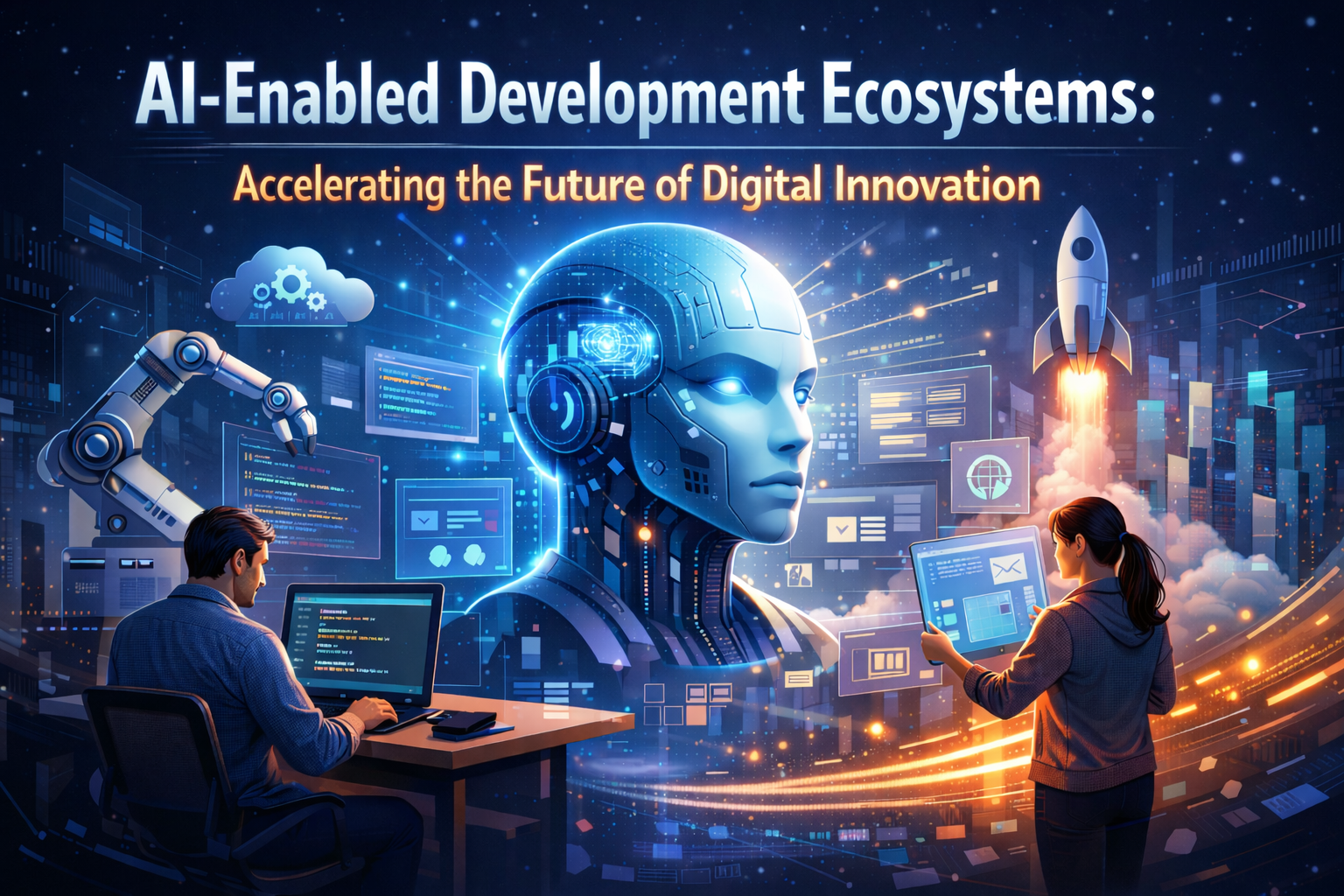

Software delivery is being re-engineered in real time. The shift isn’t just about writing code faster, it’s about designing smarter systems, reducing delivery risk, and turning engineering into a predictable business capability.
AI-powered development tools are now embedded across the software development lifecycle (SDLC): from requirements and architecture to coding, testing, deployment, monitoring, and optimization. Two changes are driving most of the real-world impact:
- Low-code/no-code platforms enhanced by AI (so more people can build, and teams can ship faster)
- AI-infused DevOps pipelines (so releases become more reliable, observable, and cost-aware)
At CloudHew, we implement AI in a practical way—focused on production outcomes, governance, and measurable delivery velocity (not “demo magic”).
Why Software Delivery Needed an AI Upgrade
Most organizations aren’t blocked by ideas. They’re blocked by execution friction:
- Requirements change faster than teams can deliver
- Dev environments drift from production
- Testing cycles are slow and brittle
- Releases fail due to manual handoffs
- Observability exists, but insights come too late
- Costs creep up quietly until CFO scrutiny hits
AI tools, applied correctly, reduce these bottlenecks by automating repetitive work, improving decision quality, and making engineering workflows more deterministic.
Low-Code/No-Code + AI
From “Citizen Development” to Governed Acceleration
Low-code and no-code tools used to be about drag-and-drop speed. Now, with AI embedded, they are becoming intelligent build environments—capable of generating UI flows, business rules, integration patterns, and even test cases.
What Low-Code and No-Code Really Mean (in 2026 terms)
- Low-code: visual development plus optional custom code for extensions, integrations, and performance tuning
- No-code: configuration-driven app assembly—great for workflows, forms, internal tools, approvals, and lightweight portals
AI makes both dramatically more usable by turning natural language intent into structured application components.
How AI Elevates Low-Code/No-Code Platforms
1) AI-Assisted App Blueprints (Requirements → Working Screens)
Instead of spending weeks on back-and-forth documentation, teams can use AI to convert business intent into:
- page layouts
- user journeys
- data entities
- validation rules
This shortens the “idea to prototype” window without sacrificing clarity.
2) Smart Workflow Suggestions (Process Design Without Guesswork)
AI can analyze common workflow patterns and recommend:
- approval routing
- exception handling
- data capture logic
- role-based access rules
This helps teams avoid building workflows that look fine in demos but break at scale.
3) Built-In Testing Intelligence
Modern platforms increasingly support AI-assisted testing, such as:
- generating test cases from workflow logic
- detecting inconsistent rules
- identifying edge cases in forms and validations
Result: fewer regressions and less manual QA overhead.
4) Faster Integrations via AI-Aided Connectors
Integration is where low-code projects often slow down. AI helps by:
- mapping fields across systems (CRM, ERP, HRMS, ticketing)
- suggesting transformation logic
- flagging incompatible schemas early
This is particularly valuable in enterprise environments with legacy systems.
5) Analytics and Optimization from Day One
AI-powered telemetry can highlight:
- where users drop off in a workflow
- which steps create delays
- which screens cause errors
So business teams can tune processes continuously—without waiting for quarterly “improvement cycles.”
What Low-Code/No-Code Is Best For
Low-code/no-code works extremely well when the goal is workflow digitization and operational speed, including:
- internal portals and dashboards
- vendor onboarding workflows
- approvals and compliance checklists
- support operations tooling
- field-service forms and inspections
- data capture + orchestration apps
Where CloudHew adds value is ensuring these solutions are secure, governed, integrated, and scalable—so they don’t become shadow IT.
AI in DevOps
From Automation to “Autonomous Delivery Intelligence”
DevOps already automated builds and deployments. AI takes DevOps further by turning pipelines into systems that can:
- detect risk earlier
- predict failures
- recommend safer release strategies
- optimize cost and performance continuously
This is especially important as architectures become microservice-based and cloud consumption becomes a board-level concern.
Where AI Improves CI/CD Pipelines
1) AI-Guided Code Review and Risk Detection
AI tools can flag:
- insecure code patterns
- dependency risks
- likely performance regressions
- inconsistent API usage
The goal isn’t to replace peer review—it’s to reduce review load and catch issues earlier.
2) Smarter Test Selection (Stop Running Everything Every Time)
Instead of running full test suites on every commit, AI can help decide:
- which tests are most relevant to the change
- where regression likelihood is highest
This reduces cycle time while keeping confidence high.
3) Predictive Release Safety
AI can learn from historical deployment and incident data to predict:
- which services are most fragile
- which release windows are safest
- where rollback probability is high
This increases release frequency without increasing operational anxiety.
4) Pipeline Optimization for Throughput
AI can identify “hidden bottlenecks” across build steps, artifact creation, and environment provisioning—then recommend improvements that raise throughput and stability.
AI for Observability, Monitoring, and Reliability
Predictive Incident Prevention
Instead of reacting to outages, AI models can detect early warning signals:
- error-rate drift
- latency degradation patterns
- memory pressure trends
- unusual traffic behavior
This enables proactive remediation, not “postmortem-driven engineering.”
Automated Anomaly Detection
AI improves alert quality by reducing noise and correlating signals across logs, metrics, and traces—helping teams focus on what actually matters.
Intelligent Scaling and Cost Control
AI can help optimize scaling decisions by predicting demand and tuning resources—especially in Kubernetes and cloud-native environments—balancing performance and spend.
AI Improves DevOps Collaboration Too
AI-driven assistants can streamline cross-team handoffs by:
- summarizing incidents and root-cause hypotheses
- generating change logs and release notes automatically
- tracking deployment status across services
- creating runbooks from resolved incident patterns
This reduces cognitive load and speeds up response during high-pressure situations.
What’s Next: The Shift Toward Agentic Development
The next wave of AI in engineering will be less “autocomplete” and more autonomous agents operating within guardrails. Expect increasing adoption of:
- agents that create PRs for routine fixes
- automated refactoring agents for modernization
- incident-response agents that propose mitigations
- policy-aware governance agents for compliance and security
But none of this works without strong architecture, identity, observability, and cost attribution. AI doesn’t eliminate engineering discipline—it raises the bar for it.
How CloudHew Helps You Apply AI Without Creating New Risk
AI tools can accelerate delivery—or create chaos—depending on how they’re implemented. CloudHew focuses on production-grade enablement:
- AI-assisted engineering workflows aligned to SDLC controls
- DevSecOps integration (security and compliance baked in)
- Cloud-native pipeline modernization with measurable throughput gains
- Observability + SRE practices enhanced by AI-driven insight
- Governance for low-code/no-code so speed doesn’t create shadow systems
The result: faster releases, fewer incidents, higher developer productivity, and better cost discipline.
Conclusion
AI-powered software development tools are no longer optional—they’re becoming the default operating model for modern engineering teams. Low-code/no-code platforms accelerate application delivery and empower broader teams, while AI-infused DevOps makes releases more reliable, observable, and cost-efficient.
The winners won’t be the teams that “try AI.”
They’ll be the teams that operationalize AI, with the right architecture, governance, and execution model.
If you’re ready to move from experimentation to production-grade acceleration, CloudHew can help you design a secure, scalable AI-driven development lifecycle that delivers predictable outcomes.