
Modern enterprises operate in increasingly complex technology environments powered by cloud computing, AI-driven applications, microservices architectures, and distributed infrastructure systems. Managing these ecosystems through traditional IT support models is becoming increasingly inefficient.
This is where AI-powered managed services and AIOps (Artificial Intelligence for IT Operations) are transforming the way organizations monitor, optimize, and manage their technology infrastructure.
At CloudHew, we help enterprises modernize their IT operations through AI-driven managed services, cloud infrastructure management, DevOps automation, and intelligent monitoring systems that improve operational efficiency, security, and scalability.
AI-powered managed services enable organizations to move beyond reactive monitoring and manual troubleshooting toward predictive, autonomous, and self-healing IT environments.
The Evolution of Managed Services in the Digital Era
Traditional managed services focused primarily on IT infrastructure monitoring, patch management, system maintenance, and helpdesk support. While these capabilities remain essential, modern digital enterprises require far more advanced operational intelligence.
Organizations today rely on:
- Hybrid cloud infrastructure
- Multi-cloud platforms such as Azure, AWS, and Oracle Cloud
- Microservices and containerized applications
- Continuous integration and DevOps pipelines
- AI-powered business applications
- Large-scale data analytics platforms
Managing these environments manually introduces significant operational challenges such as:
- Increased downtime risk
- Infrastructure complexity
- Inefficient cloud resource usage
- Delayed incident detection
- Cybersecurity vulnerabilities
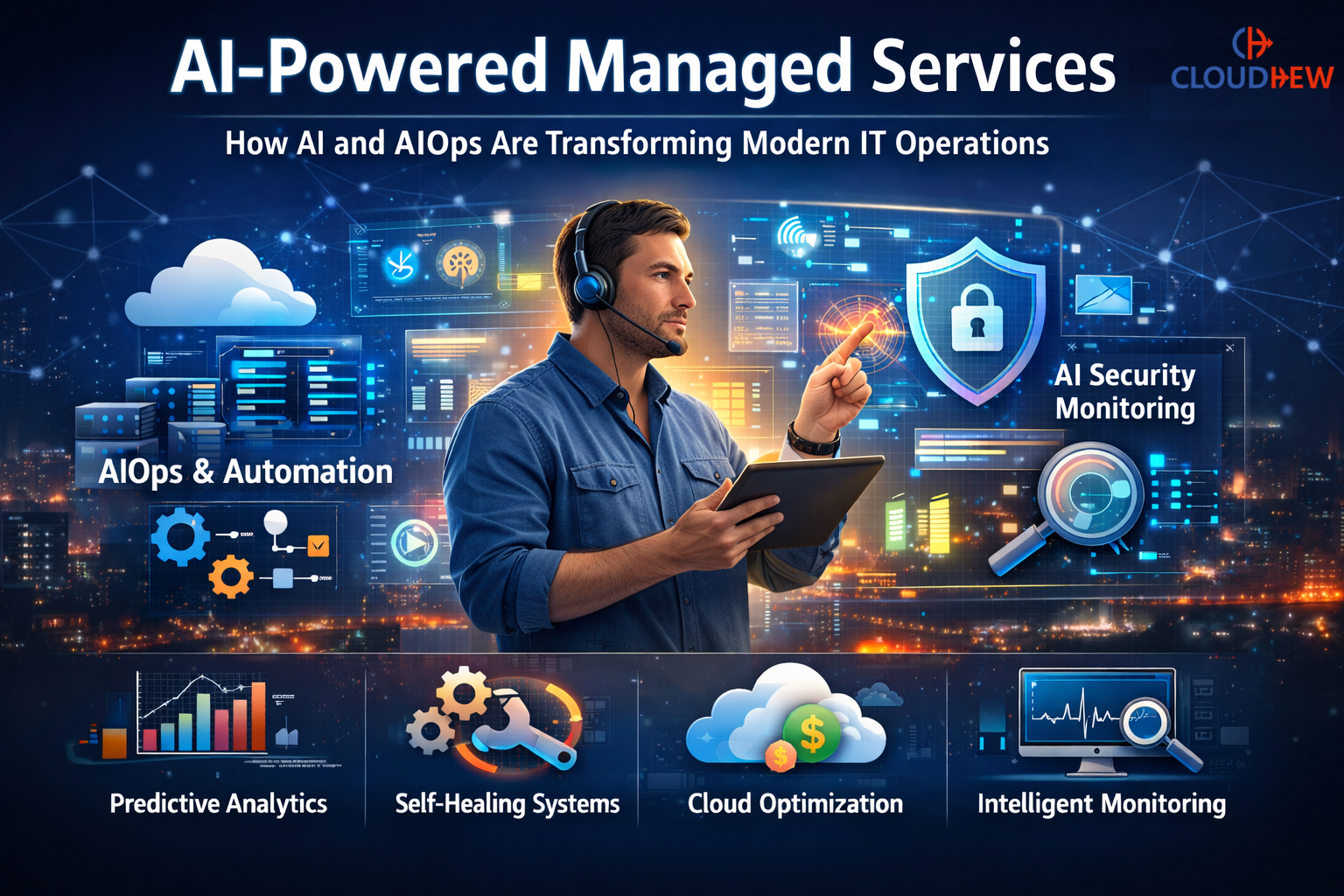
AI-driven managed services introduce a smarter operational model where machine learning algorithms, predictive analytics, and automation continuously monitor infrastructure and automatically resolve operational issues.
This evolution represents the shift from reactive IT support to intelligent IT operations powered by AIOps platforms.
What Are AI-Powered Managed Services?
AI-powered managed services integrate machine learning, automation frameworks, predictive analytics, and intelligent monitoring tools into traditional IT operations.
Instead of relying solely on manual monitoring and human-driven troubleshooting, AI systems continuously analyze operational data to detect anomalies, predict infrastructure failures, and automate remediation workflows.
AI-driven managed services typically combine:
- AI-powered infrastructure monitoring
- Predictive analytics for IT operations
- Automated incident remediation
- Intelligent cloud optimization
- AI-driven cybersecurity monitoring
- DevOps automation and platform engineering
These technologies enable organizations to reduce operational risk, improve uptime, and optimize infrastructure performance across hybrid and multi-cloud environments.
Key Capabilities of AI-Driven Managed Services
AI-Driven Infrastructure Monitoring (AIOps)
Traditional monitoring tools generate alerts when predefined thresholds are crossed. However, modern infrastructure generates enormous volumes of telemetry data that require more advanced analysis.
AIOps platforms use machine learning algorithms to analyze logs, metrics, and traces across infrastructure layers to identify abnormal behavior patterns.
This enables operations teams to detect issues such as:
- Infrastructure bottlenecks
- Application latency spikes
- Network congestion
- Database performance degradation
- Unusual user activity patterns
By detecting anomalies early, AI-driven monitoring enables faster incident response and improved system reliability.
Predictive IT Operations
Predictive analytics allows managed service providers to anticipate infrastructure issues before they disrupt business operations.
Machine learning models analyze historical system data to predict:
- Server failures
- Storage capacity shortages
- Traffic spikes
- Hardware degradation
- Application performance issues
This predictive capability significantly reduces downtime and improves system resilience.
Intelligent Automation and Self-Healing Systems
Automation is a critical component of modern managed services.
AI-powered automation platforms can automatically trigger remediation actions when anomalies are detected.
Examples include:
- Restarting failed services
- Automatically scaling cloud infrastructure
- Patching vulnerable systems
- Balancing workloads across servers
- Adjusting system configurations
These self-healing IT systems reduce operational overhead and improve service reliability.
AI-Powered Cybersecurity Monitoring
Cybersecurity threats continue to evolve rapidly. AI-powered security monitoring systems analyze massive volumes of network and system data to detect suspicious behavior.
AI-driven security operations enable capabilities such as:
- Anomaly-based threat detection
- Automated incident response
- Security event correlation
- Vulnerability scanning
- Insider threat monitoring
These capabilities strengthen enterprise security posture and ensure compliance with modern regulatory standards.
Cloud Cost Optimization and FinOps
Cloud environments can quickly become expensive when resources are not optimized.
AI-driven cloud cost optimization platforms analyze usage patterns to identify cost-saving opportunities such as:
- Rightsizing compute resources
- Eliminating idle infrastructure
- Optimizing storage allocation
- Forecasting future cloud costs
When combined with FinOps frameworks, AI-powered managed services enable organizations to maintain cost-efficient cloud operations without sacrificing performance.
AI-Driven Observability: The Foundation of Modern IT Operations
Observability platforms combine logging, monitoring, tracing, and analytics to provide deep visibility into application performance and infrastructure behavior.
AI-powered observability solutions correlate signals across systems to identify root causes of operational issues.
Capabilities include:
- Distributed tracing across microservices
- Real-time application performance monitoring
- Intelligent root cause analysis
- Infrastructure dependency mapping
- Predictive performance analytics
This level of visibility enables enterprises to manage large-scale digital infrastructure environments with confidence.
Automation-First IT Operations
Modern managed services increasingly follow an automation-first architecture where repetitive operational tasks are automated.
AI-powered automation can manage:
- Infrastructure provisioning
- Kubernetes cluster scaling
- CI/CD pipeline monitoring
- Automated patch management
- System configuration management
This allows IT teams to focus on innovation rather than routine operational tasks.
AI Copilots and Autonomous IT Operations
One of the most exciting developments in managed services is the emergence of AI copilots for IT operations teams.
These systems leverage Generative AI and large language models (LLMs) to assist engineers with infrastructure troubleshooting and decision-making.
AI copilots can:
- Analyze system logs in real time
- Summarize incidents
- Recommend remediation steps
- Generate automation scripts
- Optimize infrastructure configurations
Over time, these technologies will enable fully autonomous IT operations environments where AI manages routine tasks independently.
Benefits of AI-Powered Managed Services
Organizations adopting AI-driven managed services gain several competitive advantages.
Improved System Reliability
Predictive monitoring and automated remediation reduce outages and improve uptime.
Faster Incident Resolution
AI-powered analytics helps teams identify root causes faster, reducing mean time to resolution (MTTR).
Increased Operational Efficiency
Automation eliminates repetitive tasks, allowing teams to focus on strategic initiatives.
Scalable Infrastructure Management
AI systems can manage complex multi-cloud environments without increasing operational overhead.
Enhanced Security
AI-driven threat detection improves cybersecurity posture and compliance readiness.
How CloudHew Delivers AI-Driven Managed Services
CloudHew delivers enterprise-grade AI-powered managed services and cloud infrastructure management solutions that enable organizations to operate intelligent digital platforms.
Our capabilities include:
- AI-powered infrastructure monitoring (AIOps)
- Cloud managed services for Azure, AWS, and Oracle Cloud
- DevOps automation and CI/CD optimization
- Predictive performance analytics
- AI-driven cybersecurity monitoring
- Hybrid and multi-cloud infrastructure management
- Platform engineering and container orchestration
Learn more about our services:
By integrating AI, automation, and advanced observability platforms, CloudHew helps enterprises transform IT operations into autonomous, resilient, and scalable digital infrastructure ecosystems.
The Future of AI-Powered Managed Services
The future of managed services will be shaped by technologies such as:
- AIOps platforms
- Generative AI for IT operations
- AI-powered automation frameworks
- Autonomous cloud infrastructure
- Intelligent security operations
- AI copilots for engineering teams
Organizations that adopt these technologies early will gain a competitive advantage through improved operational efficiency, enhanced security, and optimized digital infrastructure management.
Frequently Asked Questions
What are AI-powered managed services?
AI-powered managed services use artificial intelligence, automation, and predictive analytics to monitor, manage, and optimize IT infrastructure and cloud environments.
What is AIOps in managed services?
AIOps stands for Artificial Intelligence for IT Operations. It uses machine learning and data analytics to automate infrastructure monitoring, incident detection, and remediation.
How does AI improve managed services?
AI improves managed services by enabling predictive monitoring, automated incident response, intelligent resource optimization, and enhanced security threat detection.
What are the benefits of AI-driven managed services?
Benefits include improved uptime, faster incident resolution, optimized cloud costs, enhanced cybersecurity, and scalable infrastructure management.
What is cloud managed services?
Cloud managed services involve outsourcing the management of cloud infrastructure, applications, and platforms to a specialized service provider.
How does AI help in cloud cost optimization?
AI analyzes cloud usage patterns and recommends resource optimization strategies such as rightsizing, auto-scaling, and eliminating unused infrastructure.
What industries benefit from AI managed services?
Industries such as finance, healthcare, SaaS, retail, and manufacturing benefit significantly from AI-driven managed services.
What is predictive IT operations?
Predictive IT operations use machine learning models to forecast infrastructure issues before they impact business operations.
What are self-healing IT systems?
Self-healing systems automatically detect and resolve infrastructure issues without human intervention.
What role does DevOps play in managed services?
DevOps enables continuous integration, automated deployments, and efficient infrastructure management within managed services environments.
How does AI improve cybersecurity operations?
AI analyzes network and system data to detect unusual behavior patterns, enabling faster threat detection and automated security responses.
What is AI observability?
AI observability combines monitoring, logging, and tracing with machine learning to analyze system performance and identify root causes of issues.
Can AI reduce operational costs in IT?
Yes. AI automation reduces manual operational tasks, optimizes resource utilization, and improves efficiency.
What are autonomous IT operations?
Autonomous IT operations use AI systems to manage infrastructure automatically with minimal human intervention.
How do managed service providers use AI?
MSPs use AI for predictive monitoring, automated remediation, intelligent analytics, and cloud infrastructure optimization.
What is the future of managed services?
The future includes AI-driven automation, autonomous IT operations, and AI copilots assisting infrastructure engineers.