
Software development is entering a new era.
For decades, engineering teams followed a predictable model: product managers defined requirements, designers created interfaces, and developers translated those ideas into code line by line. While this model built the digital world we know today, it is increasingly struggling to keep up with modern product demands.
Today’s applications evolve faster than ever. Companies are expected to launch new features continuously, adapt to user feedback quickly, and integrate with complex cloud ecosystems.
At the same time, a powerful new force has entered the development workflow: Artificial Intelligence.
AI-powered development tools, large language models, and code-generation systems are changing how engineers build software. Instead of manually writing every line of code, developers now collaborate with AI systems that can generate, refactor, test, and optimize code in real time.
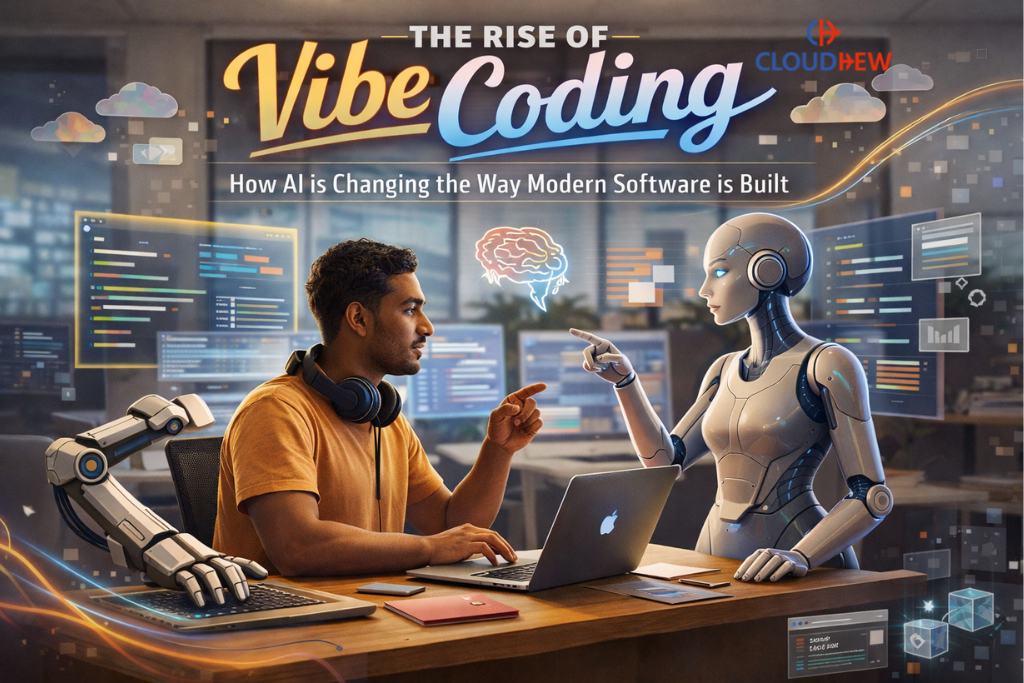
This shift is giving rise to a new development paradigm known as Vibe Coding, a modern engineering approach where developers guide AI systems using intent, context, and product understanding rather than relying purely on manual coding.
Organizations exploring Vibe Coding services are discovering that this model dramatically improves developer productivity, accelerates product delivery, and enables teams to innovate faster.
What is Vibe Coding?
Vibe Coding is a modern development approach that combines human creativity with AI-assisted coding workflows.
Instead of focusing solely on writing code syntax, developers concentrate on defining the intent, functionality, and user experience of the software while AI systems assist in generating and optimizing the underlying code.
In practical terms, Vibe Coding means:
- Developers describe what the system should do.
- AI tools generate foundational code structures.
- Engineers refine, optimize, and guide the implementation.
- Teams iterate quickly through experimentation.
The result is a development process that is faster, more creative, and more aligned with product thinking.
This approach is fundamentally different from traditional development, where writing code manually consumes most of the engineering effort.
With Vibe Coding, developers shift from code writers to system architects and product engineers.
Organizations that adopt this approach are able to accelerate development cycles while maintaining high-quality software architecture.
CloudHew works with organizations to implement modern development frameworks like Vibe Coding, enabling engineering teams to adopt AI-assisted workflows and build scalable cloud-native applications faster.
Why Vibe Coding Is Becoming Popular
The rapid rise of Vibe Coding is not accidental. Several major trends are pushing the software industry toward this model.
AI Development Tools Are Transforming Engineering
Tools like GitHub Copilot, generative AI models, and intelligent IDE assistants are enabling developers to generate code snippets, documentation, and tests instantly.
Industry studies show that AI coding assistants can increase developer productivity by 30–55%, allowing engineers to spend more time solving complex problems rather than writing repetitive code.
Faster Product Development Cycles
Modern companies operate in extremely competitive markets. Businesses must launch new features quickly to stay ahead.
Traditional development models struggle to keep up with this pace, especially when teams are dealing with complex microservices architectures and cloud infrastructure.
Vibe Coding allows teams to prototype and iterate rapidly, enabling faster product releases.
Rise of AI-Native Engineering Teams
Many modern startups and technology companies are now building AI-native development teams, where engineers rely heavily on AI assistants as part of their daily workflow.
This shift is creating a new engineering culture where developers collaborate with AI systems as productivity partners.
Core Principles of Vibe Coding
Vibe Coding is more than simply using AI tools. It is a mindset shift in how software is designed and built.
Several key principles define this development philosophy.
Intent-Driven Development
In traditional development, engineers spend significant time implementing low-level code logic.
Vibe Coding prioritizes defining the intent of the system rather than focusing on syntax. Developers communicate goals and expected behavior, while AI systems assist with code generation.
This allows engineers to focus on architecture and product design rather than repetitive implementation tasks.
AI-Assisted Coding Workflows
AI tools play a central role in Vibe Coding workflows.
These tools can:
- Generate code blocks
- Refactor legacy code
- Write documentation
- Detect bugs
- Suggest architecture improvements
Developers remain in control while AI acts as an intelligent assistant.
Rapid Experimentation
Vibe Coding encourages experimentation.
Because AI can generate code quickly, teams can test multiple product ideas in shorter timeframes. This enables organizations to validate concepts earlier in the development cycle.
Developer Creativity + AI Acceleration
One of the most powerful aspects of Vibe Coding is the combination of human creativity and machine speed.
Developers bring domain expertise, design thinking, and problem-solving abilities, while AI accelerates implementation.
This synergy enables teams to build sophisticated software faster than ever before.
How Vibe Coding Improves Developer Productivity
Developer productivity is one of the biggest challenges facing modern technology organizations.
Engineering teams often spend large portions of their time writing repetitive code, debugging basic issues, and maintaining legacy systems.
Vibe Coding addresses these challenges in several ways.
Reducing Boilerplate Coding
Many software projects involve writing similar foundational code structures repeatedly.
AI-assisted development tools can generate these components instantly, allowing developers to focus on more complex and creative tasks.
Faster Prototyping
Rapid prototyping is essential for modern product development.
With Vibe Coding, engineers can build functional prototypes in hours rather than weeks, enabling faster feedback from product teams and stakeholders.
Smarter Debugging
AI models can analyze code patterns and suggest fixes for errors, helping developers identify issues quickly.
This reduces debugging time and improves overall development efficiency.
Enhanced Collaboration
Vibe Coding encourages collaboration between product teams, designers, and engineers.
Because development becomes more intent-driven, teams can communicate ideas more effectively and iterate quickly.
Real-World Applications of Vibe Coding
The impact of Vibe Coding is already visible across multiple industries.
Startup Product Development
Startups often need to launch products quickly with limited engineering resources.
Vibe Coding enables smaller teams to build sophisticated platforms faster by leveraging AI-assisted development workflows.
SaaS Platform Development
Software-as-a-Service companies frequently release new features and integrations.
Vibe Coding allows SaaS engineering teams to maintain rapid innovation cycles while ensuring code quality.
Enterprise Internal Tools
Large organizations often require custom internal applications for operations, analytics, and automation.
AI-assisted development significantly reduces the time required to build these systems.
AI-Powered Applications
Applications that integrate AI features, such as chatbots, recommendation engines, or predictive analytics, benefit greatly from Vibe Coding frameworks.
The Role of AI in Vibe Coding
Artificial Intelligence is the foundation that makes Vibe Coding possible.
Large Language Models (LLMs) trained on massive code datasets can understand programming patterns and generate functional code.
These systems can assist developers with tasks such as:
- Code generation
- Automated testing
- Documentation writing
- Architecture suggestions
- Debugging and optimization
In the future, AI agents may be capable of managing entire development workflows, from writing code to deploying applications.
This evolution will transform the role of developers from implementers to system designers and AI orchestrators.
How CloudHew Helps Organizations Implement Vibe Coding
Adopting Vibe Coding requires more than simply installing AI tools.
Organizations must redesign development workflows, establish governance frameworks, and ensure that AI-generated code integrates securely with enterprise systems.
CloudHew helps companies implement Vibe Coding through:
- AI-powered development frameworks
- Cloud-native architecture design
- Developer productivity optimization
- Modern DevOps and CI/CD pipelines
- Scalable application engineering
By combining AI development practices with cloud infrastructure expertise, CloudHew enables organizations to build modern software platforms faster while maintaining enterprise-grade reliability.
The Future of Software Development
The software industry is moving toward a future where human developers and AI systems collaborate closely.
Engineering teams will increasingly rely on AI to automate repetitive tasks while focusing on innovation and system design.
In this environment, Vibe Coding will become a core engineering practice.
Companies that adopt this model early will gain a major advantage in product development speed and innovation capacity.
The question is no longer whether AI will influence software development.
The real question is how quickly organizations can adapt their engineering culture to work alongside AI effectively.
Vibe Coding represents the beginning of this transformation.
What is Vibe Coding?
Vibe Coding is a modern software development approach where developers collaborate with AI-powered coding tools to generate, refine, and optimize code. It focuses on intent-driven development rather than manual coding.
Is Vibe Coding replacing traditional development?
No. Vibe Coding enhances traditional development by augmenting developers with AI tools. Engineers still design system architecture and validate code quality.
How does AI help developers code faster?
AI tools can generate boilerplate code, detect bugs, recommend optimizations, and assist with documentation. This allows developers to focus on higher-level engineering tasks.
What tools are used in Vibe Coding?
Common tools include AI coding assistants, generative AI models, intelligent IDE plugins, and automated testing frameworks.
How can companies adopt Vibe Coding?
Organizations can adopt Vibe Coding by integrating AI-assisted development tools, updating engineering workflows, and training developers to collaborate effectively with AI systems.