
Cloud Architecture Is Now a Business Growth Decision
The era of viewing the cloud merely as a remote data center is officially over. Today, enterprise cloud architecture is the foundation of competitive differentiation. It is no longer just an IT infrastructure decision—it directly impacts an organization’s speed to market, operational cost, AI readiness, customer experience, security posture, and overall business scalability.
Enterprises are aggressively moving beyond basic lift-and-shift cloud migration. Rushing to simply host legacy applications on virtual machines is a recipe for inflated budgets and operational bottlenecks. Today, enterprise technology leaders—CIOs, CTOs, and Infrastructure Heads—need cloud environments that are scalable, secure, meticulously cost-efficient, automation-ready, and fundamentally designed to support next-generation workloads like Agentic AI and Retrieval-Augmented Generation (RAG).
“The enterprises that win with cloud will not be the ones that migrate fastest, but the ones that architect for resilience, intelligence, cost control, and scale.”
Why Cloud Architecture Needs a Rethink
Despite widespread cloud adoption, many organizations find themselves trapped in a state of operational immaturity. They have achieved the migration, but they have not achieved the transformation. This friction stems from several compounding enterprise challenges:
- Rising Cloud Costs: Variable pricing models, unmanaged egress fees, and over-provisioned resources are driving unpredictable spikes in cloud bills.
- Poor Cloud Governance: The proliferation of decentralized deployments has led to a massive increase in “shadow data” dispersed across multi-cloud and SaaS environments, creating immense compliance risks.
- Legacy Application Dependency: Monolithic applications forced into the cloud without refactoring fail to leverage native elasticity.
- Multi-Cloud Complexity: Operating across disparate environments without unified control planes causes extreme operational overhead.
- Security and Compliance Pressure: The expansion of the attack surface in distributed systems demands deeper, identity-first security measures.
- AI Workload Demands: Traditional compute environments are choking under the intensive data pipeline and GPU requirements of large language models (LLMs) and machine learning tasks.
- Skills Gaps: A critical shortage of talent spanning DevOps, Kubernetes, data orchestration, and cloud-native security.
- Poor Visibility: Abstracted infrastructure layers are leaving teams blind to root-cause failures and precise performance metrics.
The Business Impact:
A mid-sized enterprise may execute a successful cloud migration strategy to move workloads to the cloud, but still see 25–40% wasted cloud spend due to poor architecture, over-provisioning, lack of resource tagging, and weak FinOps governance. Modernization requires a fundamental rethink of how infrastructure is provisioned and managed.
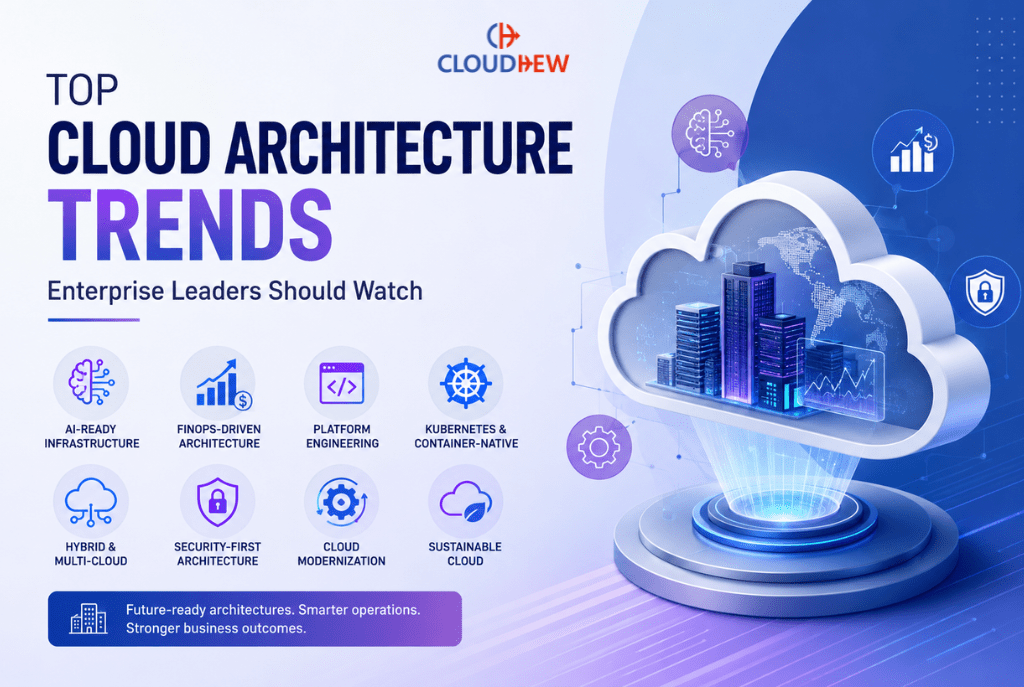
Trend 1: AI-Ready Cloud Infrastructure
The most disruptive force in technology today is the integration of enterprise AI. However, AI workloads are breaking old cloud assumptions. Elastic compute means very little if your data pipelines cannot keep up, and provisioning GPUs is futile if storage latency becomes the primary bottleneck. Architecting an AI-ready cloud infrastructure is now a mandatory baseline for innovation.
- GPU-Ready Infrastructure
- Data Pipeline Readiness
- Scalable Storage Architecture
- Secure Model Deployment
- MLOps and AIOps
- Hybrid AI Workloads
- Cost Control for AI Compute
CloudHew Consulting Advantage:
CloudHew helps enterprises critically assess whether their current cloud architecture is truly ready for AI adoption before they invest heavily in AI pilots, ensuring that data pipelines and compute architectures can sustain intelligent workloads.
Trend 2: FinOps-Driven Cloud Architecture
Historically, cost management was a reactive exercise performed by finance teams long after infrastructure was provisioned. Today, cloud cost optimization is an integral engineering discipline. FinOps is no longer an afterthought; it is built into the fabric of the architecture itself.
- Cost-Aware Architecture
- Resource Rightsizing
- Reserved Instances and Savings Plans
- Automated Cost Alerts
- Chargeback/Showback Models
- Cloud Tagging Strategy
- Waste Reduction
Need to reduce cloud spend without slowing innovation? CloudHew can help you identify architecture-level cost leaks across AWS and Azure, embedding FinOps directly into your deployment pipelines.
Trend 3: Platform Engineering Becomes Core to Cloud Success
The cognitive load on software developers has reached a breaking point. Platform engineering has emerged as the strategic solution to this problem, dramatically improving the developer experience, automation, deployment speed, and overarching cloud governance.
- Internal Developer Platforms (IDPs)
- Golden Paths
- Infrastructure-as-Code (IaC)
- CI/CD Pipelines
- Self-Service Environments
- Policy-as-Code
- Standardized Cloud Landing Zones
Trend 4: Kubernetes and Container-Native Architecture
Kubernetes has firmly established itself as the operating system of the modern cloud. It is central to enterprise cloud-native architecture, providing unmatched scalability and portability. However, it is also notoriously complex to manage at an enterprise scale.
- Multi-Cluster Management
- Container Security
- Service Mesh
- Auto-Scaling
- Observability
- GitOps
- Kubernetes Cost Governance
- AI and Data Workload Orchestration
Trend 5: Hybrid and Multi-Cloud Architecture
The debate over which single cloud provider to choose is largely obsolete. Enterprises are intentionally designing multi-cloud architecture and hybrid cloud strategy environments, balancing the unique strengths of AWS, Azure, on-premises private clouds, edge locations, and SaaS platforms.
- Avoiding Vendor Lock-In
- Data Sovereignty
- Disaster Recovery
- Workload Placement Strategy
- Cross-Cloud Networking
- Identity and Access Management
- Unified Monitoring
Trend 6: Cloud Security Architecture by Design
In a distributed, API-driven world, the traditional perimeter defense model is entirely ineffective. Cloud security architecture must be embedded into the infrastructure from day one, rather than bolted on as an afterthought.
- Zero Trust Architecture
- Identity-First Security
- Conditional Access
- Network Segmentation
- Encryption
- Secrets Management
- Compliance Automation
- Cloud Posture Management (CSPM)
- Least Privilege Access
CloudHew helps enterprises design and implement secure cloud environments across AWS, Azure, Microsoft 365, Kubernetes, and automated DevOps pipelines.
Trend 7: Observability, AIOps, and Autonomous Cloud Operations
As systems grow exponentially more complex, human operators can no longer manually correlate errors across thousands of microservices. The industry is rapidly shifting from reactive monitoring to intelligent, autonomous operations—often referred to as Cognitive Platform Engineering.
- Logs, Metrics, Traces
- Incident Prediction
- Root-Cause Analysis
- Automated Remediation
- SLOs and SLAs
- Cloud Performance Dashboards
- AI-Assisted Operations
Trend 8: Cloud Modernization Over Simple Migration
The consensus among digital transformation leaders is clear: simple migration does not create strategic value. Moving a flawed architecture to a new data center merely changes the billing address of the problem. True enterprise cloud transformation requires deep cloud modernization.
Mini Case Study: Enterprise Cloud Transformation
Scenario: A growing enterprise had executed a rapid migration of workloads to Azure and AWS. However, they soon faced unsustainable cloud bills, agonizingly slow deployment cycles, poor visibility into system performance, and inconsistent security controls.
CloudHew Approach: Cloud architecture assessment, cost optimization audit, landing zone redesign, Kubernetes architecture review, CI/CD and IaC implementation, security baseline setup, and monitoring improvement.
Outcome: 30% reduction in unnecessary cloud spend, 40% faster deployment cycles, improved cloud governance, stronger security posture, and better scalability for AI and data workloads.
Cloud Architecture Readiness
- Is your cloud cost visible by business unit?
- Do you have a clear AWS/Azure landing zone strategy?
- Are your workloads designed for resilience?
- Do you use infrastructure-as-code?
- Is Kubernetes properly governed?
- Are AI workloads planned in your architecture?
- Do you have cloud security guardrails?
- Are backups and disaster recovery tested?
- Do you have real-time observability?
- Is your architecture aligned with business goals?
Why Choose CloudHew
Navigating the complexities of modern IT requires more than just technical hands; it requires strategic vision. CloudHew is a premier enterprise cloud consulting and software engineering partner dedicated to aligning technology infrastructure with business growth.
- AWS and Azure cloud architecture
- Cloud migration and modernization
- Kubernetes and DevOps
- Cloud cost optimization
- Platform engineering
- AI-ready infrastructure
- Security and governance
- Managed cloud services
- Enterprise application modernization
Ready to Modernize Your Enterprise Cloud?
Is your cloud architecture truly ready for scale, AI, advanced security, and precise cost control? Building an infrastructure that can support tomorrow’s demands requires deliberate action today. CloudHew helps enterprises assess, design, modernize, and optimize complex cloud environments across AWS, Azure, Kubernetes, DevOps, and AI-ready infrastructure.
Book a Cloud Architecture Assessment with CloudHew today.
FAQs
What is enterprise cloud architecture?
Enterprise cloud architecture is the strategic design and organization of a company’s cloud computing environments.
Why is cloud architecture important for digital transformation?
It provides the foundational agility required for digital transformation. A well-designed architecture enables rapid deployment of new services, seamless scaling to meet customer demand, and integration of advanced analytics.
What are the latest cloud architecture trends?
Key trends include the shift toward AI-ready infrastructure, the integration of FinOps for continuous cost optimization, the rise of platform engineering, and widespread adoption of multi-cloud strategies.
How does FinOps improve cloud architecture?
FinOps brings financial accountability to the variable spend model of the cloud by embedding cost-awareness into the architectural design phase.
Why is AI-ready cloud infrastructure important?
AI workloads require distinct infrastructure characteristics: massive data processing capabilities, ultra-low latency storage, and specialized GPU compute resources.
What is the difference between cloud migration and cloud modernization?
Cloud migration simply moves an existing application to a cloud server. Cloud modernization involves refactoring or rewriting the application to utilize cloud-native features.
How can CloudHew help with AWS and Azure cloud architecture?
CloudHew acts as a strategic consulting partner, helping enterprises design secure, multi-account landing zones, optimize existing deployments, and implement advanced DevOps automation.
When should an enterprise redesign its cloud architecture?
When they experience consistently unpredictable cloud costs, frequent system outages, sluggish deployment cycles, or when current infrastructure cannot support new technologies.