
Enterprise IT is no longer a support function. It has become the operating system of the modern business.
In 2026, companies across industries are under pressure to modernize faster, automate deeper, reduce technology costs, and build digital platforms that can scale with changing business demands. At the same time, artificial intelligence is changing how software is built, how infrastructure is managed, how data is used, and how enterprise workflows are automated.
But for many organizations, the reality is more complex.
Legacy applications still run critical operations. Cloud costs continue to rise. Development teams are stretched thin. Data remains fragmented across systems. AI pilots are increasing, but many are not reaching production. Security, compliance, and governance requirements are expanding faster than internal teams can manage.
This is where the next wave of enterprise transformation begins.
The organizations pulling ahead are not simply adopting AI tools or migrating workloads to the cloud. They are rebuilding their technology foundation with modern software architecture, cloud-native infrastructure, intelligent automation, secure data platforms, and responsible AI engineering.
CloudHew helps enterprises design, build, modernize, and manage these future-ready technology ecosystems.
The Enterprise IT Challenge in 2026
Technology leaders today are being asked to solve multiple business problems at the same time:
- Reduce infrastructure and operational costs
- Improve application performance
- Modernize legacy software
- Accelerate product development
- Build AI-enabled workflows
- Improve developer productivity
- Strengthen cybersecurity and compliance
- Enable real-time business intelligence
- Scale digital platforms across geographies and business units
The challenge is that most enterprise systems were not built for this level of speed, intelligence, and integration.
Many organizations are still operating with outdated systems, disconnected databases, manual workflows, and complex application dependencies. These issues create friction across every layer of the business.
Cloud modernization, AI engineering, and software development are now converging into one strategic priority: building intelligent, scalable, secure, and cost-efficient digital operations.
Seven Enterprise Technology Problems CloudHew Helps Solve
1. Legacy Applications Are Slowing Business Growth
Many enterprises continue to depend on applications built years ago using outdated architecture, monolithic codebases, and limited integration capabilities.
These systems often create:
- Slow release cycles
- High maintenance costs
- Poor scalability
- Security vulnerabilities
- Integration challenges
- Limited AI readiness
- Poor user experience
Legacy modernization is no longer optional. It is the foundation for digital growth.
CloudHew helps enterprises modernize legacy systems through application re-engineering, API modernization, cloud-native architecture, microservices, containerization, and DevOps automation.
2. Cloud Migration Without Modernization Increases Cost
Many organizations move workloads to the cloud expecting immediate efficiency. But lift-and-shift migration often transfers old inefficiencies into a new environment.
Without proper modernization, enterprises face:
- Overprovisioned infrastructure
- Rising cloud bills
- Poor workload performance
- Unoptimized storage and compute
- Inefficient Kubernetes clusters
- Lack of visibility into usage
- Weak cloud governance
CloudHew helps organizations move beyond migration by designing optimized cloud architectures across Azure, AWS, hybrid cloud, and multi-cloud environments.
The goal is not just to move to the cloud. The goal is to make the cloud work efficiently for the business.
3. AI Adoption Is Moving Faster Than Governance
Enterprises are experimenting with generative AI, AI agents, copilots, and AI-assisted development tools. But without proper engineering discipline, AI can introduce new risks.
Common enterprise AI risks include:
- Hallucinated outputs
- Poor data quality
- Uncontrolled automation
- Security gaps
- Lack of audit trails
- Weak model governance
- Compliance exposure
- AI-generated technical debt
CloudHew helps enterprises build AI systems that are secure, governed, explainable, and aligned with business workflows.
This includes AI architecture, LLM integration, custom model development, intelligent automation, data pipelines, and responsible AI governance.
4. Software Development Teams Are Under Pressure to Deliver Faster
Business teams want faster releases, better digital products, and continuous innovation. Engineering teams are expected to deliver more with fewer delays.
But development velocity is often blocked by:
- Manual testing
- Poor CI/CD pipelines
- Legacy code complexity
- Unclear requirements
- Weak DevOps maturity
- Infrastructure bottlenecks
- Lack of reusable engineering platforms
CloudHew supports enterprises with custom software development, product engineering, application modernization, DevOps implementation, QA automation, and platform engineering.
The outcome is faster delivery without compromising quality, security, or scalability.
5. Data Is Too Fragmented for AI and Analytics
AI success depends on data readiness.
Many organizations still operate with disconnected systems, inconsistent reporting, duplicate records, and undocumented data flows. This prevents teams from building reliable dashboards, predictive models, and AI-powered workflows.
CloudHew helps enterprises modernize their data foundation through:
- Data lakes
- Data warehouses
- ETL pipelines
- Real-time analytics
- Data modernization
- Business intelligence dashboards
- AI-ready data platforms
- Data governance frameworks
With the right data architecture, organizations can move from reactive reporting to predictive decision-making.
6. Enterprise Automation Is Still Too Manual
Many enterprise workflows still depend on repetitive manual tasks across departments such as finance, HR, operations, sales, procurement, IT, and customer support.
These workflows create delays, errors, and unnecessary operational costs.
CloudHew builds intelligent automation solutions using AI, workflow engines, API integrations, RPA, and enterprise software platforms.
Automation opportunities include:
- Document processing
- Invoice workflows
- Vendor onboarding
- Customer support
- Internal approvals
- IT service requests
- Compliance reporting
- Sales and CRM operations
The result is faster operations, lower cost, and better process visibility.
7. Managed IT Operations Need to Become Proactive
Traditional support models are reactive. Teams respond after something breaks.
Modern enterprises need proactive monitoring, predictive alerts, automated remediation, and continuous optimization.
CloudHew provides managed services across applications, infrastructure, cloud environments, data systems, and enterprise platforms.
This helps organizations reduce downtime, improve reliability, optimize cost, and maintain business continuity.
Enterprise Technology Use Cases CloudHew Delivers
Custom Software Development
CloudHew builds scalable enterprise applications, SaaS platforms, web portals, mobile applications, APIs, and business software tailored to specific operational needs.
Key capabilities include:
- Web application development
- Mobile application development
- SaaS product engineering
- API development
- Backend engineering
- Frontend development
- Enterprise workflow platforms
- Custom business applications
Application Modernization
CloudHew helps organizations upgrade outdated applications into modern, scalable, secure digital systems.
Modernization services include:
- Monolith to microservices transformation
- Legacy code refactoring
- API modernization
- Cloud-native redesign
- Database modernization
- UI/UX modernization
- Performance optimization
- Security hardening
Cloud Consulting & Modernization
CloudHew helps enterprises design, migrate, optimize, and manage cloud environments across Azure and AWS.
Cloud capabilities include:
- Cloud migration
- Cloud architecture
- Azure consulting
- AWS consulting
- Kubernetes implementation
- DevOps automation
- Infrastructure as Code
- Cloud cost optimization
- Hybrid and multi-cloud strategy
AI Engineering & Automation
CloudHew designs and builds AI-enabled systems that improve enterprise productivity and decision-making.
AI capabilities include:
- Generative AI applications
- AI agents
- LLM integration
- AI-powered automation
- Predictive analytics
- NLP solutions
- Computer vision
- Custom ML model development
- AI governance frameworks
Data Engineering & Analytics
CloudHew helps organizations convert raw data into actionable business intelligence.
Data capabilities include:
- Data lake implementation
- Data warehouse modernization
- ETL pipeline development
- Real-time dashboards
- Power BI analytics
- Predictive analytics
- Data quality monitoring
- Data governance
DevOps & Platform Engineering
CloudHew helps engineering teams improve delivery speed, reliability, and release quality.
DevOps capabilities include:
- CI/CD pipeline setup
- Kubernetes deployment
- Containerization
- Infrastructure automation
- Monitoring and observability
- Release management
- QA automation
- Developer productivity tooling
Managed IT & Application Services
CloudHew provides long-term managed services for applications, cloud infrastructure, data platforms, and enterprise systems.
Managed service capabilities include:
- Application monitoring
- Cloud infrastructure support
- Performance optimization
- Incident management
- Security updates
- Database support
- SLA-driven support
- Continuous improvement
Transformation Stories: Enterprise IT Case Studies
The following case studies are written in the same strategic style as the uploaded healthcare AI document, which uses transformation stories with business context, CloudHew solution approach, measurable outcomes, and technology stack references.
Case Study 01 : Legacy Application Modernization for a Mid-Sized Enterprise
Client Profile
A mid-sized enterprise operating across multiple business units was dependent on a legacy internal application used for operations, approvals, reporting, and customer service workflows.
The platform had become slow, difficult to maintain, and expensive to upgrade. Business teams were requesting new features, but every small change required significant development effort because of outdated architecture and tightly coupled modules.
Business Challenges
The organization faced several critical issues:
- Slow application performance
- High maintenance cost
- Poor user experience
- No mobile-friendly interface
- Manual approval workflows
- Limited reporting capabilities
- Security vulnerabilities
- Difficulty integrating with third-party systems
The legacy system was directly affecting productivity and delaying business decisions.
CloudHew Solution
CloudHew redesigned the application using a modern cloud-native architecture.
The transformation included:
- Rebuilding the application with a modern frontend and scalable backend
- Migrating key modules to a microservices-based architecture
- Creating secure APIs for internal and external integrations
- Modernizing the database layer
- Implementing role-based access control
- Automating approval workflows
- Building real-time dashboards
- Deploying the platform on cloud infrastructure
- Setting up CI/CD pipelines for faster releases
Technology Stack
- React
- .NET / Java backend services
- Azure / AWS cloud infrastructure
- REST APIs
- SQL / NoSQL database modernization
- CI/CD pipelines
- Role-based access control
- Power BI dashboards
Business Impact
- 48% improvement in application performance
- 35% reduction in manual operational effort
- 42% faster feature release cycle
- 30% reduction in annual maintenance cost
- Improved user adoption across departments
- Better visibility through real-time reporting
Strategic Outcome
The client moved from a rigid legacy platform to a scalable enterprise application that could support new workflows, integrations, automation, and future AI capabilities.
Case Study 02: Cloud Modernization & Cost Optimization for a Growing SaaS Company
Client Profile
A fast-growing SaaS company was scaling rapidly but facing rising infrastructure costs and performance issues during peak usage periods.
The company had already moved to the cloud, but its architecture was not optimized for scale. Cloud spend was increasing every month, and engineering teams had limited visibility into resource usage.
Business Challenges
The SaaS company faced:
- Increasing monthly cloud bills
- Poor workload optimization
- Limited autoscaling
- Frequent performance bottlenecks
- Manual deployment processes
- Weak monitoring and alerting
- Lack of FinOps governance
- Difficulty scaling for customer growth
Cloud infrastructure had become a cost center instead of a growth enabler.
CloudHew Solution
CloudHew conducted a cloud architecture assessment and implemented a modernization roadmap focused on performance, cost, automation, and scalability.
The solution included:
- Cloud resource audit
- Workload right-sizing
- Kubernetes optimization
- Autoscaling configuration
- Infrastructure as Code implementation
- CI/CD pipeline modernization
- Observability and monitoring setup
- Cost dashboards and governance policies
- Database performance optimization
Technology Stack
- Azure / AWS
- Kubernetes
- Docker
- Terraform
- CI/CD pipelines
- Cloud monitoring tools
- Application performance monitoring
- Cost optimization dashboards
Business Impact
- 32% reduction in cloud infrastructure cost
- 55% faster deployment cycles
- 40% improvement in application response time
- 60% reduction in manual infrastructure tasks
- Improved uptime during peak traffic
- Better cost visibility for leadership teams
Strategic Outcome
The company transformed its cloud environment into a scalable, optimized, and cost-controlled infrastructure foundation capable of supporting long-term SaaS growth.
Case Study 03: AI-Powered Workflow Automation for Enterprise Operations
Client Profile
A multi-location enterprise services company was managing several operational workflows manually across departments, including document processing, approvals, customer requests, vendor onboarding, and internal reporting.
As the business scaled, manual workflows became slow, error-prone, and difficult to track.
Business Challenges
The organization struggled with:
- High dependency on manual data entry
- Delayed approval cycles
- Repetitive administrative tasks
- Lack of workflow visibility
- Increased operational errors
- Slow customer response times
- Disconnected tools and systems
- Poor reporting accuracy
The leadership team wanted to reduce operational friction and improve process efficiency without increasing headcount.
CloudHew Solution
CloudHew implemented an AI-powered workflow automation platform that connected existing systems, automated repetitive tasks, and introduced intelligent decision support.
The solution included:
- Workflow automation engine
- AI-based document classification
- Automated data extraction
- Approval routing
- Integration with CRM and internal systems
- Real-time process dashboards
- Exception handling workflows
- Notification and escalation automation
Technology Stack
- AI / ML models
- OCR and document intelligence
- Workflow automation engine
- REST APIs
- CRM integration
- Cloud database
- Power BI dashboards
- Secure access controls
Business Impact
- 50% reduction in manual processing time
- 45% faster approval workflows
- 38% reduction in operational errors
- 30% improvement in customer response time
- Real-time visibility into process status
- Better compliance through audit trails
Strategic Outcome
The client shifted from manual operations to intelligent automation, enabling faster execution, better control, and improved scalability.
Case Study 04
Data Engineering & Analytics Modernization for Executive Decision-Making
Client Profile
A growing enterprise had data spread across multiple systems, including CRM, ERP, finance tools, spreadsheets, customer support platforms, and operational databases.
Leadership teams were relying on delayed reports and inconsistent metrics, making it difficult to make timely business decisions.
Business Challenges
The organization faced:
- Fragmented data sources
- Manual reporting processes
- Inconsistent business metrics
- Duplicate data records
- Limited real-time visibility
- Slow dashboard generation
- Poor data quality
- No predictive analytics capability
The company needed a unified data platform to support analytics, reporting, and future AI use cases.
CloudHew Solution
CloudHew built a modern data engineering and analytics platform that consolidated data from multiple business systems into a centralized reporting and intelligence layer.
The solution included:
- Data source integration
- ETL pipeline development
- Data warehouse modernization
- Data quality validation
- Business intelligence dashboards
- Role-based analytics access
- Automated reporting workflows
- Predictive analytics foundation
Technology Stack
- Azure / AWS data services
- Data warehouse
- ETL pipelines
- Power BI
- SQL / NoSQL databases
- Data quality checks
- API integrations
- Predictive analytics models
Business Impact
- 65% reduction in manual reporting effort
- 40% faster executive decision-making
- 35% improvement in reporting accuracy
- Unified business dashboards across departments
- Better visibility into revenue, operations, and customer performance
- AI-ready data foundation for future use cases
Strategic Outcome
The enterprise moved from fragmented reporting to a centralized data intelligence platform, enabling faster decisions and improved business visibility.
Enterprise Technology Architecture: What a Modern IT Foundation Looks Like
A modern enterprise technology ecosystem requires more than individual tools. It needs an integrated architecture across software, cloud, data, AI, security, and operations.
Application Layer
- Custom enterprise applications
- SaaS platforms
- Mobile applications
- API-first systems
- Microservices architecture
- Modern user interfaces
Cloud Infrastructure Layer
- Azure and AWS cloud platforms
- Kubernetes clusters
- Serverless services
- Infrastructure as Code
- Autoscaling
- Backup and disaster recovery
Data Layer
- Data lakes
- Data warehouses
- ETL pipelines
- Real-time streaming
- Business intelligence dashboards
- Data governance
AI & Automation Layer
- Generative AI applications
- AI agents
- Predictive analytics
- NLP models
- OCR automation
- Intelligent workflow systems
- Custom ML models
DevOps & Engineering Layer
- CI/CD pipelines
- Automated testing
- Release automation
- Observability
- Performance monitoring
- Platform engineering
Security & Governance Layer
- Identity and access management
- Zero Trust principles
- DevSecOps
- Compliance monitoring
- Audit logging
- Data protection
- AI governance
This integrated architecture allows enterprises to scale faster, operate more efficiently, and adopt AI responsibly.
ROI Benchmarks: What Enterprises Can Expect
| Transformation Area | Typical Time to Value | Primary Metric | Benchmark Outcome |
| Application Modernization | 3–6 months | Maintenance cost reduction | 25–40% reduction |
| Cloud Cost Optimization | 30–90 days | Monthly cloud spend | 20–35% reduction |
| DevOps Automation | 60–120 days | Deployment frequency | 40–70% improvement |
| AI Workflow Automation | 60–120 days | Manual effort reduction | 35–60% reduction |
| Data Platform Modernization | 3–6 months | Reporting efficiency | 40–65% improvement |
| Managed Application Services | 30–90 days | Incident resolution time | 30–50% faster |
| Custom Software Development | 3–9 months | Operational productivity | 25–45% improvement |
| AI-Powered Analytics | 3–6 months | Decision-making speed | 30–50% improvement |
Implementation Note
Time to value depends on the organization’s current architecture, data maturity, security requirements, integration complexity, and internal stakeholder readiness.
CloudHew typically recommends starting with a structured technology assessment to identify the highest-impact modernization opportunities before development begins.
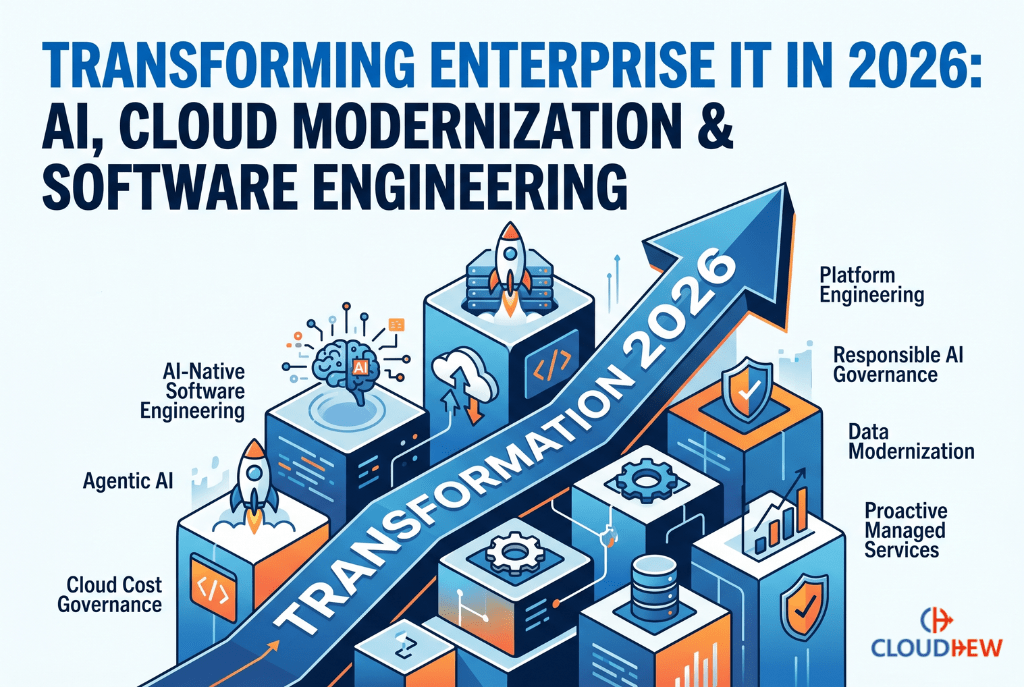
Enterprise Technology Trends Shaping 2026–2030
1. AI-Native Software Engineering
AI will become a permanent part of the software development lifecycle. Engineering teams will increasingly use AI for coding, testing, documentation, debugging, and deployment support.
However, enterprises will need governance to prevent AI-generated technical debt.
2. Agentic AI for Enterprise Operations
AI agents will automate multi-step business workflows across IT, finance, HR, customer service, sales, procurement, and operations.
The next challenge will be orchestration, monitoring, and control.
3. Cloud Cost Governance Will Become a Board-Level Priority
As AI and data workloads grow, cloud costs will become more complex. Enterprises will need FinOps, workload optimization, and intelligent infrastructure management.
4. Platform Engineering Will Improve Developer Productivity
Enterprises will invest in internal developer platforms to standardize deployment, infrastructure, monitoring, security, and reusable engineering workflows.
5. Data Modernization Will Determine AI Success
Organizations with clean, connected, governed data will extract far more value from AI than those with fragmented systems.
6. Managed Services Will Become More Proactive
Managed IT will move from reactive support to predictive monitoring, automated remediation, and continuous optimization.
7. Responsible AI Governance Will Become Mandatory
As enterprises deploy AI into real business operations, governance, auditability, security, and compliance will become essential.
Why Enterprises Partner with CloudHew
CloudHew is an AI, cloud, and software development consulting company helping enterprises modernize their technology foundation for the next phase of digital growth.
We bring together software engineers, cloud architects, AI specialists, DevOps experts, data engineers, and managed services teams to deliver complete transformation programs.
CloudHew Capabilities
AI Engineering & Automation
Custom AI solutions, generative AI applications, AI agents, NLP, computer vision, predictive analytics, and intelligent workflow automation.
Cloud Modernization
Azure and AWS cloud migration, cloud-native architecture, Kubernetes, DevOps, infrastructure optimization, and cost governance.
Software Development
Custom web applications, SaaS platforms, enterprise portals, mobile apps, backend systems, API development, and product engineering.
Data Engineering & Analytics
Data lakes, data warehouses, ETL pipelines, BI dashboards, real-time analytics, data modernization, and AI-ready data platforms.
Application Modernization
Legacy application modernization, microservices transformation, UI/UX modernization, database modernization, and performance optimization.
Managed Services
Application support, infrastructure monitoring, cloud operations, performance management, incident response, and continuous improvement.
CloudHew’s Engagement Model
CloudHew follows an outcomes-first delivery model.
1. Assessment
We evaluate the current technology environment, business goals, application landscape, cloud readiness, data maturity, security requirements, and automation opportunities.
2. Roadmap
We define a phased modernization roadmap with clear priorities, estimated effort, target architecture, business impact, and ROI expectations.
3. Architecture
We design scalable, secure, cloud-native, AI-ready architecture aligned with enterprise requirements.
4. Implementation
We build, modernize, integrate, automate, and deploy solutions using agile delivery practices.
5. Optimization
We continuously monitor, optimize, secure, and improve the solution after deployment.
Build Future-Ready Enterprise Technology with CloudHew
Enterprise transformation is no longer about adopting isolated tools. It is about building a modern technology foundation that supports AI, automation, cloud scalability, data intelligence, and continuous innovation.
CloudHew helps organizations modernize applications, optimize cloud infrastructure, build intelligent software, automate operations, and scale digital platforms with confidence.
Ready to modernize your enterprise technology stack?
Talk to CloudHew’s AI, Cloud & Software Engineering experts today.
FAQ
CloudHew provides IT consulting, software development, AI engineering, cloud modernization, data engineering, DevOps, application modernization, and managed services for enterprises.
CloudHew builds custom enterprise applications, SaaS platforms, web portals, mobile apps, APIs, backend systems, and cloud-native software products tailored to business requirements.
Yes. CloudHew helps organizations migrate, modernize, optimize, and manage workloads on Azure, AWS, hybrid cloud, and multi-cloud environments.
Yes. CloudHew modernizes legacy applications through refactoring, re-platforming, API modernization, cloud-native redesign, database modernization, and microservices transformation.
Yes. CloudHew develops AI solutions including generative AI applications, AI agents, predictive analytics, NLP systems, computer vision models, intelligent automation, and custom ML solutions.
CloudHew improves cloud cost efficiency through workload assessment, right-sizing, autoscaling, Kubernetes optimization, cost dashboards, infrastructure automation, and FinOps governance.
CloudHew supports enterprises across healthcare, technology, SaaS, manufacturing, logistics, finance, retail, education, and professional services.
CloudHew combines software engineering, cloud modernization, AI engineering, data platforms, automation, and managed services into one integrated technology transformation approach.