
AI coding tools have moved from autocomplete assistants to active engineering collaborators. For enterprise teams, this changes everything.
A developer may use AI to generate an isolated function in seconds, but an enterprise still needs secure architecture, scalable code, reliable testing, DevOps governance, compliance controls, and production-grade engineering discipline. The real question for technology leaders is no longer “which tool writes code faster?” but rather: Which tool helps enterprise teams build, modernize, secure, and scale software responsibly?
As organizations integrate these technologies into modern software delivery models, cloud modernization initiatives, and continuous deployment pipelines, choosing the right platform determines whether you are accelerating innovation or compounding technical debt.
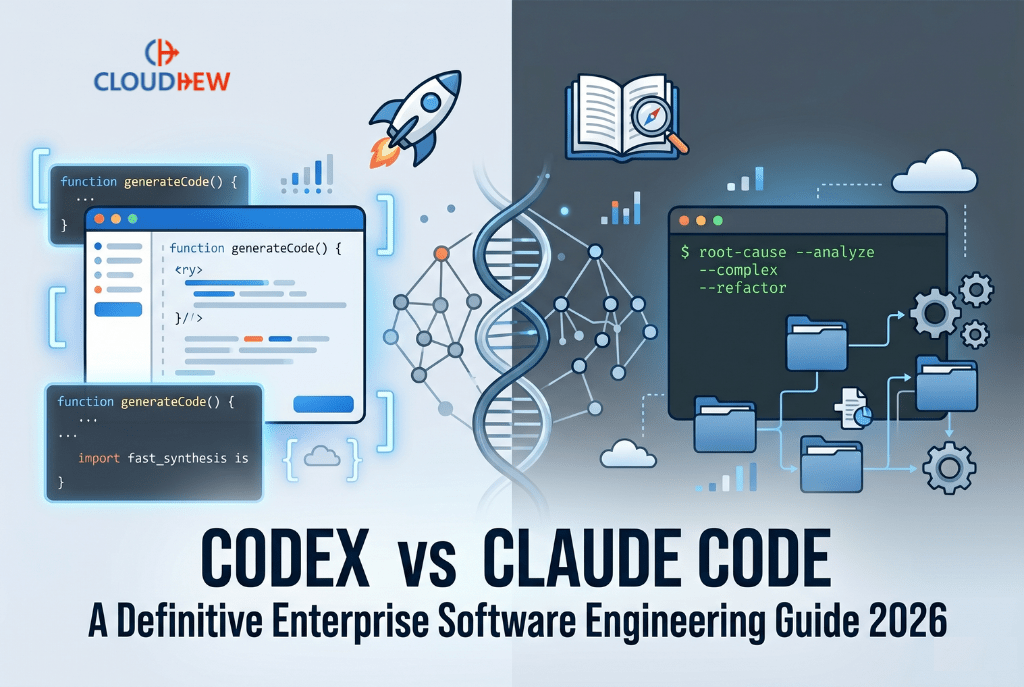
Here is a definitive engineering guide comparing OpenAI Codex and Anthropic’s Claude Code for enterprise environments.
1. What Is OpenAI Codex?
OpenAI Codex is a specialized AI code generation engine optimized for high-velocity code synthesis, direct code completion, and task execution. Built as a descendant of GPT architectures, Codex excels at transforming natural language prompts into working syntax across dozens of programming languages.
For enterprise application development, Codex serves as an efficient developer workflow acceleration mechanism. It functions as an optimized autocomplete engine that operates within integrated development environments (IDEs) to manage routine code patterns.
Core Strengths of OpenAI Codex for Developers:
- Fast Code Generation: Synthesizes standard code blocks, helper methods, and foundational classes with minimal latency.
- Boilerplate Automation: Eliminates repetitive manual entry by instantly scaffolding standard architectural patterns (e.g., MVC structures, standard configurations).
- API and Full-Stack Task Support: Quickly generates frontend components, database queries, and API route mappings based on established schemas.
- Developer Workflow Acceleration: Minimizes context-switching by providing real-time inline suggestions as developers type, making it ideal for high-volume, predictable engineering sprints.
2. What Is Claude Code?
Claude Code represents a paradigm shift from simple autocomplete tools toward agentic AI software engineering. Operating natively in the terminal and powered by Anthropic’s state-of-the-art models, Claude Code is designed as an agentic system capable of deep codebase analysis, multi-file execution, and system-level reasoning.
Rather than just predicting the next line of code, Claude Code can read entire repositories, execute shell commands, manage local testing frameworks, and autonomously orchestrate large-scale development workflows with user-granted permissions.
Core Strengths of Claude Code for Enterprises:
- Deep Multi-File Reasoning: Analyzes complex logical dependencies across large systems and context windows extending beyond 200,000 tokens.
- Advanced Architecture & Structural Context: Understands how disparate modules, databases, and microservices interact, supporting thoughtful system-wide interventions.
- Automated Refactoring & Legacy Modernization: Tracks down architectural patterns across undocumented systems, making it highly effective for migrating outdated enterprise stacks.
- Toolchain & CI/CD Integration: Connects directly with local development tools, Git, and external frameworks via the Model Context Protocol (MCP), automating test execution and patch verification.
3. Codex vs Claude Code: Quick Comparison Table
To understand the core architectural differences between basic code autocomplete architectures and advanced agentic structures, review this high-level comparison matrix:
| Parameter | OpenAI Codex | Claude Code | Best For |
| Primary Focus | Fast code generation | Complex reasoning & workflows | Choosing speed vs. architectural depth |
| Coding Speed | Very high (sub-second suggestions) | Moderate (deliberate multi-step planning) | Inline writing vs. system overhaul |
| Debugging | Direct, localized fixes | Deep root-cause analysis | Immediate patches vs. multi-service tracking |
| Refactoring | Repetitive syntax changes | Structural and architectural changes | Local cleanups vs. legacy migrations |
| Large Codebases | Targeted edits via active file context | Comprehensive repository-scale context | Isolated files vs. distributed systems |
| Testing | Quick unit test scaffolding | Edge-case verification & test execution | Basic code coverage vs. regression validation |
| Documentation | Basic structural inline comments | Rich system architectural explanations | Simple docstrings vs. system runbooks |
| Enterprise Use | Individual developer productivity | Architectural integrity & system reliability | Execution speed vs. enterprise stability |
| Best Team Fit | High-velocity, feature-focused teams | Quality-driven engineering organizations | Scaling boilerplate vs. managing complexity |
4. Coding Performance: Speed vs. Reasoning
In enterprise software engineering, raw text output speed rarely correlates to project success. The value of an AI coding assistant depends heavily on the alignment between the complexity of the engineering task and the underlying capabilities of the AI.
When OpenAI Codex Excels (Speed & Automation)
Codex is highly effective when the engineering task is clearly bounded, structured, or pattern-driven. Because its execution pipeline is designed for immediate code completion, it eliminates the cognitive drag of writing repetitive code. Excellent enterprise use cases include:
- Creating standardized API endpoints and controllers.
- Generating standard CRUD (Create, Read, Update, Delete) database screens.
- Writing boilerplate initialization files and boilerplate data objects.
- Scaffolding standard integrations with well-documented public APIs.
When Claude Code Excels (Deep System Reasoning)
Claude Code becomes necessary when a task requires semantic comprehension of business logic scattered across multiple files. It handles complex, ambiguous prompts by first planning its steps, then reading files, and validating its work against your local system. It excels at:
- Diagnosing transient bugs that cross the boundaries of multiple microservices.
- Reviewing legacy structures to identify undocumented technical debt.
- Refactoring tightly coupled codebase modules into decoupled architectures.
- Maintaining state and memory across complex, multi-hour engineering tasks through specialized local workspace context files (like CLAUDE.md).
5. Debugging Comparison
In enterprise environments, debugging is rarely about fixing one broken line of code. It typically requires analyzing distributed tracing logs, parsing hidden state dependencies, assessing database query side-effects, navigating CI/CD pipelines, and verifying authentication layers.
The Enterprise Reality: A localized fix that breaks an upstream microservice isn’t a solution—it’s an incident.
- Codex approaches debugging as a localized translation problem. If you paste a specific code block and an explicit stack trace into an IDE prompt, Codex can quickly identify syntax mismatches, missing null checks, or incorrect API invocations. It provides immediate, direct fixes for isolated errors.
- Claude Code operates as an engineering investigator. Working directly in the terminal, it can run the local build command, capture the stack trace, search the entire project directory for instances of the failing component, trace variables through the call hierarchy, edit the files, and run the test suite to ensure the fix doesn’t cause regressions elsewhere.
6. Refactoring and Legacy Modernization
Legacy application modernization remains one of the largest resource drains for enterprise technology teams. Whether it is breaking down monoliths or executing cross-language migrations, manual refactoring introduces high risks of disruption.
Enterprises increasingly leverage AI coding platforms to optimize these transformations. However, the tools serve distinctly different functions in modernization pipelines:
- Codex for Pattern Repetition: Once an architect defines a migration pattern, Codex accelerates execution by rapidly translating syntax across individual files. It handles the manual conversion of repetitive modules with high fidelity.
- Claude Code for Architectural Alignment: Claude Code can digest an entire monolithic structure, analyze how business domains interact, map out dependency graphs, and systematically execute structural modifications across dozens of files simultaneously. For instance, in large-scale language migrations (such as moving legacy services to modern enterprise runtimes), Claude Code can autonomously plan and execute multi-file migrations in fractions of the time traditionally required.
To safely scale modernization initiatives without risking production downtime, organizations require a balanced framework that combines automated reasoning with rigorous architectural control.
7. Test Generation and Code Quality
Ensuring enterprise code quality requires robust validation frameworks that span multiple testing strategies. While both tools generate test syntax, they perform differently when integrated into institutional quality assurance (QA) practices.
- Unit Test Generation: Codex excels at rapidly generating standard unit tests. It evaluates a single file, builds test scaffolds using frameworks like JUnit or pytest, and populates mock data blocks efficiently.
- Integration and Edge-Case Coverage: Claude Code provides significant advantages for complex testing. Because it understands system-wide data flows, it can identify subtle boundary conditions, generate thorough integration tests that interact with external services, and proactively write security test cases to prevent vulnerabilities like SQL injection or broken access controls.
While AI platforms significantly accelerate test generation, engineering teams must maintain human validation steps and rigorous quality gates before allowing AI-generated tests to clear production CI/CD pipelines.
8. Enterprise Security and Compliance Considerations
For regulated industries—such as healthcare, banking, financial services (BFSI), public sector, and high-growth SaaS—casual AI usage presents clear compliance risks. Enterprise security teams must strictly evaluate data privacy, intellectual property protections, and access controls before deploying development tools across large teams.
Critical AI Security Governance Vectors:
- Code Privacy & Data Retention: Organizations must ensure that vendor agreements guarantee zero data retention policies. Code snippets and enterprise proprietary logic must never be ingested to train public foundation models.
- Vulnerability Proliferation: AI platforms can inadvertently replicate insecure coding patterns found in their training data. Security architectures must implement automated static application security testing (SAST) and software supply chain scans to evaluate all AI-generated contributions.
- Regulatory Compliance (SOC 2, HIPAA, GDPR): Development assistants must work cleanly within corporate access boundaries, ensuring that sensitive data fields or personally identifiable information (PII) are fully redacted before processing.
9. Developer Productivity vs. Engineering Governance
Integrating AI into software delivery velocity can introduce unintended downstream impacts if it isn’t paired with strong institutional policies.
AI Software Engineering Accelerates Development. Engineering Governance Makes It Production-Ready.
When engineering velocity accelerates without architectural oversight, organizations often face an explosion of technical debt, unvetted third-party dependencies, and fragmented documentation. True production readiness requires balancing speed with established governance mechanisms:
- Rigorous Pull Request (PR) Policies: Enforcing mandatory peer reviews and strict linting rules for any branches modified by an AI agent.
- Architecture Review Boards: Ensuring that system-wide modifications remain aligned with core architectural principles rather than uncoordinated tactical adjustments.
- Observability & Traceability: Embedding detailed logging and tracing tags into codebases to guarantee that automated changes remain completely auditable.
10. When Should Enterprises Use Codex?
OpenAI Codex remains an exceptional solution for development environments that prioritize individual developer velocity and localized execution.
- Fast Prototyping: Accelerating the creation of greenfield applications and initial proof-of-concept projects.
- Boilerplate and Scaffold Generation: Automating standard setups, entity classes, data transport schemas, and configuration models.
- Standard Web and Feature Engineering: Building standard frontend UI components, simple form components, and straightforward CRUD functionalities.
- API Scaffolding: Rapidly drafting standard integrations, endpoints, and data validation layers.
- Junior Developer Onboarding: Providing real-time, inline syntax suggestions to help early-career engineers master institutional code conventions.
11. When Should Enterprises Use Claude Code?
Claude Code is the optimal choice for organizations managing large code repositories, complex legacy architectures, and highly regulated distributed systems.
- Legacy Code Analysis and Refactoring: Evaluating, documenting, and modernizing dense legacy applications or monolithic service architectures.
- Complex Multi-File Debugging: Tracing and resolving complex bugs that bridge across different services, files, and functional components.
- Systems Architecture and Integrity Reasoning: Making structural code updates that require a deep understanding of downstream system dependencies.
- Automated Test Orchestration: Generating, executing, and iterating on deep integration test cases natively inside the local testing runtime.
- CI/CD Failure Remediation: Analyzing build logs and pipeline failures directly within the terminal, then autonomously engineering the required software patches.
12. Should Enterprises Use Both?
For most forward-thinking engineering organizations, the ideal decision is not an exclusive choice between platforms, but rather a hybrid deployment model.
By deploying a hybrid strategy, companies can use Codex inside the IDE to maximize immediate, file-level developer coding speeds, while empowering senior engineers to utilize Claude Code from the command line to handle complex, project-wide migrations, dependency updates, and automated repository diagnostics.
13. CloudHew Perspective: AI Coding Tools Need Enterprise Engineering Discipline
At CloudHew, we recognize that AI coding tools are transformative mechanisms for engineering acceleration—but they are highly dependent on the architecture, processes, and guardrails surrounding them. True efficiency is unlocked when advanced automation is paired with deep software engineering discipline.
We collaborate with enterprises to help them responsibly adopt automated development workflows, modernize legacy code bases, and safely integrate AI technologies into their core development lifecycles.
Our Enterprise Engineering Specializations Include:
- [AI Development Services & Generative AI Consulting] Building, scaling, and implementing tailored AI architectures engineered for strict enterprise compliance environments.
- [Software Development Services & Application Modernization Services] Upgrading outdated monolithic stacks (Java, .NET) into modern, cloud-native microservices using governed AI workflows.
- [Cloud Migration Services & DevOps Consulting Services] Engineering automated, highly observable infrastructure pipelines that integrate automated quality and security gates.
- [AI Agent Development & Data Engineering Services] Building specialized agentic systems that orchestrate operations directly within complex enterprise data structures.
14. Final Verdict
There is no single winner in the Codex vs Claude Code comparison.
OpenAI Codex remains a premier choice for localized execution speed, high-velocity autocomplete generation, and routine boilerplate automation within daily IDE tasks.
Claude Code represents the next generation of software engineering tools, delivering deep system reasoning, terminal integration, agentic multi-file refactoring, and comprehensive codebase analysis.
For enterprise scale, the optimal path forward is to move past isolated code assistants and build a governed, securely orchestrated AI software engineering workflow that puts the right tool in the hands of your developers for the right task.
15. Transform Your Software Engineering with CloudHew
Planning to roll out AI coding solutions across your engineering organization? Don’t let acceleration introduce architectural fragmentation or security vulnerabilities. CloudHew helps enterprises adopt AI-assisted development through the perfect balance of automated code generation, rigorous cloud governance, secure SDLC models, and seasoned human engineering oversight.
Talk to CloudHew’s AI software engineering experts today.
Frequently Asked Questions (FAQs)
What is the primary difference between Codex and Claude Code?
OpenAI Codex is fundamentally an inline autocomplete assistant optimized for rapid code completion and boilerplate generation within individual IDE windows. Claude Code is an agentic, terminal-native system designed to analyze entire code repositories, execute command-line tasks, run local test suites, and manage multi-file structural modifications autonomously.
Is Codex better than Claude Code?
Codex is more efficient for sub-second text generation, routine function updates, and localized, pattern-based autocomplete tasks. Claude Code provides significant advantages for complex tasks requiring deep logical reasoning, dependency tracking across large context windows, and architectural refactoring.
Is Claude Code good for enterprise software development?
Yes. Claude Code is highly suited for enterprise software environments due to its large context window capabilities, direct integration with terminal workflows, and its capacity to understand deep business logic across distributed software codebases.
Can Codex and Claude Code be used together?
Yes. Many enterprise engineering teams deploy a hybrid model: developers leverage Codex inside the IDE for real-time autocomplete suggestions during feature creation, while utilizing Claude Code in the terminal to manage large structural refactoring, system-wide debugging, and automated test updates.
Can AI coding tools replace software engineers?
No. AI tools function as powerful productivity multipliers rather than human replacements. While they excel at automating manual code generation, testing, and debugging loops, human engineers remain essential for establishing system architecture, defining security bounds, validating business requirements, and owning operational production environments.
Are AI coding tools safe for enterprise codebases?
They can be safely used provided that organizations implement correct enterprise-grade licensing (guaranteeing zero data retention policies), run independent security analysis pipelines (SAST/DAST) on all generated contributions, and enforce strict human-in-the-loop validation checkpoints.
Which AI coding tool is better for legacy modernization?
Claude Code is significantly more effective for large-scale application modernization. Its ability to navigate and comprehend complex dependencies across multiple files allows it to plan and safely execute complex, multi-module architectural refactoring tasks that simple autocomplete engines cannot manage.
How can enterprises adopt AI-assisted development safely?
Enterprises should implement a structured adoption roadmap that prioritizes corporate data privacy agreements, establishes explicit developer usage guidelines, mandates automated pull request compliance validation gates, and builds explicit AI governance frameworks to mitigate security and copyright risks.
How does CloudHew help with AI-powered software engineering?
CloudHew acts as an expert implementation partner. We guide enterprise organizations through secure AI adoption, modernize complex legacy systems, build custom cloud-native applications, deploy automated DevOps pipelines, and implement the necessary quality and governance frameworks to ensure your automated engineering workflows remain resilient, scalable, and completely secure.