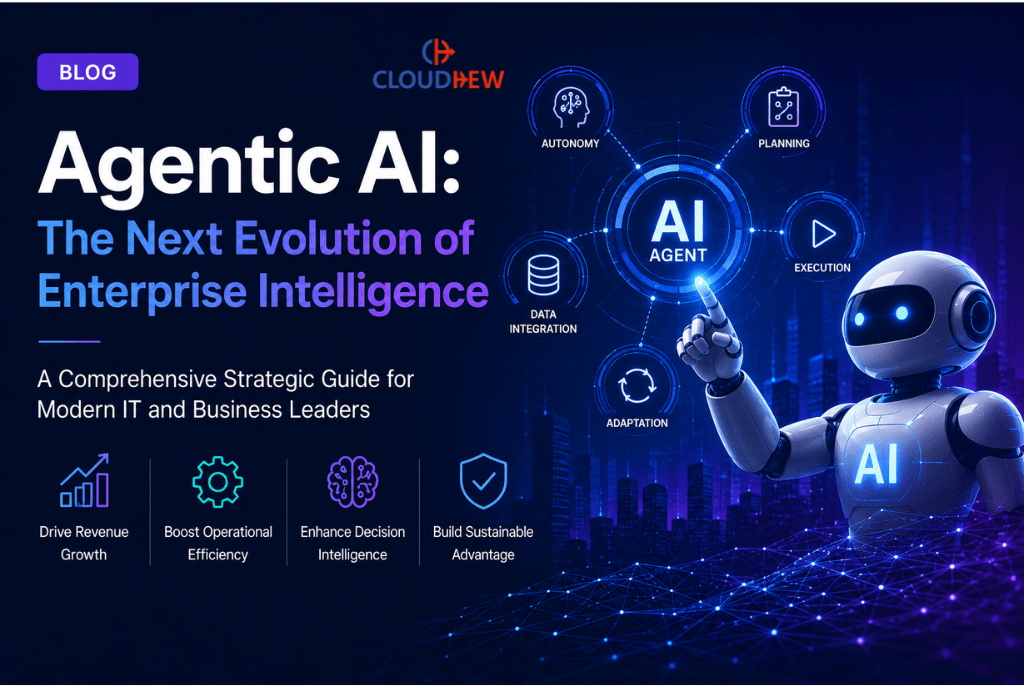

The enterprise technology landscape has fundamentally broken away from speculative hype. Across global boardrooms, a definitive shift is underway: organizations are moving past the fragile ‘science projects’ of standalone generative models toward production-grade, revenue-linked autonomous systems. According to Gartner, full-stack enterprise AI procurement spend is projected to reach $2.59 trillion, marking this era as the true inflection point where experimental pilots solidify into core architectural infrastructure.
Yet, as mid-market and large enterprises rush to deploy these technologies, a widening execution gap has emerged. While raw foundational models offer exceptional broad capabilities, they remain isolated unless anchored by robust data pipelines, scalable cloud modernization, and strict governance frameworks. The modern priority is no longer about testing what a Large Language Model (LLM) can draft; it is about building end-to-end autonomous workflows that securely execute complex, multi-step business logic across disparate enterprise systems.
| “AI adoption is fundamentally shaped by the readiness of both human capital and organizational processes, not merely by financial investment. Organizations with greater experiential maturity and self-awareness are increasingly prioritizing proven outcomes over speculative potential.”
— John-David Lovelock, Distinguished VP Analyst at Gartner |
This comprehensive guide breaks down the strategic blueprint required to transition your organization into an AI-native powerhouse. Readers will explore the architectural divergence between static automation and agentic intelligence, analyze concrete cross-industry deployment frameworks, examine the structural failure points that derail over 40% of standard enterprise AI implementations, and discover how the CloudHew Enterprise AI Framework bridges the gap between ambitious technology strategy and verifiable return on investment (ROI).
- The AI Revolution Is No Longer Coming—It’s Here
We are living through a massive technological paradigm shift. The era of casual experimentation with prompt engineering has matured into an aggressive, boardroom-led mandate for full-scale operational execution. AI is no longer treated as an isolated IT line item; it has become the primary mechanism for competitive differentiation and defensive market positioning.
Data from the field reveals that enterprise AI adoption is expanding at an unprecedented velocity:
- Production Realities: Over 72% of modern enterprises have integrated at least one AI workload into their production environments—a stark contrast to the mere 20% recorded at the start of the decade.
- Capital Commitment: Budget allocations reflect this urgency. Approximately 65% of enterprises have increased their dedicated AI capital expenditures, posting a median year-over-year investment surge of 22%.
- The Agentic Surge: The fastest-accelerating segment within this ecosystem is purpose-built AI agent software. Market data shows a massive 139% year-over-year increase in software spending for autonomous agents, highlighting a rapid migration away from simple informational chatbots toward proactive, goal-oriented systems.
This rapid expansion is driven by a stark reality: the financial divide between industry laggards and high-performing early adopters is widening. Organizations that treat AI as a core engineering discipline—integrating it directly into their underlying cloud and data architectures—realize an average return of $3.70 for every dollar invested. For top-tier tech leaders who prioritize integrated AI engineering over isolated software procurement, that return scales up to an incredible 10.3x.
- Why Enterprises Are Investing Heavily in AI
The business case for integrating Enterprise AI Solutions has evolved from speculative cost reduction to a multi-dimensional value creation strategy. Modern executives prioritize AI implementation across four distinct operational pillars:
- Revenue Growth & Market Expansion: AI is directly unlocking new top-line revenue streams. By analyzing multi-structured data sets in real time, organizations deploy hyper-personalized customer experiences that increase checkout conversion rates by 15% and average order values (AOV) by up to 20%.
- Operational Efficiency & Structural Cost Reduction: The core economic benefit of advanced automation lies in stripping friction from high-volume, complex corporate workflows. Integrating intelligent agents into enterprise service desks routinely slashes customer service expenses by up to 30% and reduces core IT operational costs by 20% to 25%.
- Decision Intelligence: Modern enterprise data is highly fragmented, siloed, and expanding at a rate that breaks traditional human analysis. AI serves as a powerful layer of decision intelligence, synthesizing massive volumes of structured operational data and unstructured corporate text instantly.
- Sustainable Competitive Advantage: In hyper-commoditized markets, the speed at which an organization processes information and adapts its strategy determines its survival. Enterprises utilizing unified Cloud and AI Services achieve unparalleled operational agility.
- Key AI Technologies Reshaping Enterprises
To construct a resilient Enterprise AI Strategy, technology leaders must understand the distinct technical capabilities and engineering requirements of the modern AI stack.
- Generative AI: Generative AI uses advanced deep learning architectures, primarily transformers, to parse, interpret, and generate highly context-aware human language. It maps semantic relationships across decades of unstructured corporate documents to deliver precise, instantaneous answers.
- AI Agents & Multi-Agent Systems: Unlike traditional software that waits for explicit human prompts, AI agents are designed for autonomous operation. Built with advanced reasoning loops, long-term memory banks, and tool-execution profiles, they plan multi-step workflows, call external APIs, and make complex decisions independently.
- Machine Learning (ML): The bedrock of predictive enterprise intelligence, machine learning algorithms excel at identifying subtle, non-linear mathematical patterns within massive historical data sets for forecasting and asset optimization.
- Computer Vision: Leveraging deep convolutional neural networks (CNNs) and vision-transformer models, computer vision allows enterprise software to accurately process visual data from production lines, security feeds, and healthcare imaging.
- Natural Language Processing (NLP): NLP bridges human communication and digital infrastructure. It powers intelligent voicebots, processes document intelligence pipelines, and automatically maps unstructured contracts directly into ERP systems.
- Predictive Analytics: Predictive analytics combines historical machine learning models with advanced statistical forecasting to determine the mathematical probability of future business outcomes, dynamic risk modeling, and resource planning.
- Real-World Enterprise AI Use Cases
To realize the true value of an Enterprise AI Implementation, abstract technology capabilities must be translated into explicit, industry-specific architectures.
| Industry | Core Use Case | Technical Architecture & Integration | Quantifiable Business Impact |
| Healthcare | Clinical Documentation & Patient Care | Ambient NLP models ingest real-time audio, converting it into structured HL7 electronic health records (EHR). Integrates with ML models analyzing biometric telemetry. | 45% reduction in administrative charting; 22% reduction in unpredicted ICU readmissions. |
| Financial Services | Real-Time Fraud & Compliance | Multi-agent systems within high-throughput streams using graph neural networks (GNNs). Localized LLMs ingest regulatory updates to flag exposure. | Sub-10ms latency in fraud intercept; 60% reduction in false-positive compliance alerts. |
| Manufacturing | Predictive Maintenance & Quality Control | Edge-computed ML models process IoT acoustic/thermal telemetry. High-speed camera arrays run vision-transformers for surface defect inspection. | 45% reduction in unplanned downtime; 99.8% precision in assembly-line quality control. |
| Retail | Hyper-Personalization & Supply Chain | Real-time vector databases match clickstreams with multi-channel profiles to alter frontends. Feeds into inventory engine balancing regional stock. | 18% increase in AOV; 30% reduction in safety stock holding costs. |
| Public Sector | Citizen Services & Smart Infrastructure | Multi-lingual conversational AI pulling from cross-department bases. Predictive analytics optimize municipal transit schedules and energy grids. | 40% improvement in service resolution times; 15% reduction in municipal energy spend. |
- Why Enterprise AI Projects Fail
Despite heavy capital investment, the path to successful deployment is fraught with systemic traps. Market research shows that over 40% of complex AI initiatives face cancellation or failure. Understanding these structural roadblocks is essential for protecting your technology investments:
- Poor Data Quality and Architectural Fragmentation: An AI model is only as reliable as the data that feeds it. Many enterprises attempt to deploy advanced reasoning models on top of siloed, fragmented, and unstandardized data landscapes.
- The Strategic Disconnect: Many AI initiatives are driven by technology fear rather than clear business objectives. When organizations launch massive AI projects without pinning them to explicit, measurable business metrics, they end up with costly novelties.
- Architectural Rigidity and Legacy System Drag: Modern AI workloads require highly elastic, scalable environments. Trying to run sophisticated enterprise models inside legacy, rigid on-premises infrastructure creates processing bottlenecks.
- Revenue-Draining Compute and Token Inflation: Autonomous agents and complex enterprise LLMs run continuously. Left unmonitored, they can generate massive volumes of API calls and consume billions of tokens, causing cost overruns.
- Governance, Security, and Risk Exposure: Deploying enterprise AI without clear governance parameters invites significant operational risk, including proprietary data leaks or severe compliance failures.
- The CloudHew Enterprise AI Framework
To overcome these structural failure points, CloudHew developed a proprietary, production-tested execution methodology. The CloudHew Enterprise AI Framework bridges the gap between ambitious business strategy and reliable, enterprise-grade deployment, ensuring every initiative delivers clear, measurable ROI.
- Discover: We begin by deeply analyzing your existing operational realities, evaluating your current technical infrastructure, assessing your data maturity model, and identifying high-value use cases.
- Design: During the design phase, our architects build a comprehensive integration blueprint, defining model strategies, safe data governance boundaries, and dynamic scaling rules.
- Develop: Here, our engineering teams build and customize your solution. We construct optimized data pipelines, implement Retrieval-Augmented Generation (RAG) systems, and develop autonomous workflows.
- Deploy: We transition your solution into production using rigorous MLOps and DevOps best practices, establishing strict security boundaries, locking down access controls, and deploying automated monitoring.
- Scale: Once live, CloudHew works alongside your teams to continually optimize the system, analyzing usage patterns to reduce compute costs and systematically expanding capabilities across additional business units.
- Building an AI-Ready Enterprise
Successfully transitioning into an AI-native enterprise requires a holistic commitment to modernizing your underlying corporate technology stack.
- Cloud Modernization as the Core Foundation: Modern AI engineering demands massive computing elasticity. Organizations must transition away from rigid infrastructure toward modern, hybrid-cloud environments built on platforms like Microsoft Azure.
- Data Modernization and Observability: To feed intelligent models effectively, enterprises must build a unified data landscape, breaking down old silos and implementing modern data lakehouses managed by a single governance plane.
- Governance, Security, and Responsible AI: As autonomous systems take on more critical tasks, comprehensive risk management is non-negotiable. Technology leaders must establish automated governance frameworks that enforce strict access controls.
- Establishing an AI Center of Excellence (CoE): To prevent fragmented, redundant AI projects, enterprises should establish a centralized CoE. This cross-functional leadership team standardizes software choices and manages metrics.
- Change Management and Talent Upskilling: The technical deployment of AI is only half the battle; success ultimately depends on organizational adoption and structured upskilling programs.
- Future Trends Every Executive Should Watch
- Advanced Agentic Ecosystems: Single-purpose, prompt-driven interfaces are giving way to complex multi-agent networks that autonomously collaborate across different corporate platforms.
- The Rise of Autonomous Enterprises: Organizations are increasingly integrating deep automation into their core operational structures, allowing processes to dynamically optimize in response to market signals.
- Ubiquitous AI Copilots: Specialized digital assistants are becoming deeply embedded inside core enterprise applications, including CRM, ERP, and HR management software.
- Multimodal AI Frameworks: Next-generation enterprise models handle far more than text, processing text, data tables, spoken audio, structural schematics, and live video streams simultaneously.
- Industry-Specific Small Language Models (SLMs): Highly targeted, smaller models trained on specialized industry data are deployed to achieve exceptional accuracy at a fraction of the compute cost.
- CloudHew Success Story (Case Study Section)
Challenge:
A global logistics and supply chain provider handling multi-market fulfillment operations was struggling with severe operational bottlenecks. Processing complex international shipping manifests and customs paperwork manually across three legacy ERP environments caused massive delays and data errors, limiting their ability to scale.
Solution:
CloudHew deployed an integrated Enterprise AI Solution built on our proprietary framework, including a document intelligence engine, an autonomous multi-agent workflow deployed on Microsoft Azure, and a secure human-in-the-loop validation layer.
Results:
- 40% reduction in operational costs via automated data extraction and validation.
- 60% faster processing cycles, reducing verification turnaround from hours to minutes.
- 3x productivity increase as human capital shifted from manual entry to edge-case resolution.
- 99.9% service availability built on a highly resilient, scalable cloud architecture.
- Why Choose CloudHew for AI Transformation
Transforming your enterprise into an AI-driven organization requires far more than model access—it demands deep engineering expertise across your entire technology stack. CloudHew is your dedicated end-to-end partner:
- AI Engineering & Generative Solutions: Specialized small language model fine-tuning and production-grade RAG pipelines.
- AI Agent Development: Designing goal-oriented multi-agent networks that execute complex multi-step corporate operations.
- Data Engineering & Analytics: Architecting modern data lakehouses and high-throughput pipelines.
- Cloud Modernization & Azure Expertise: Building auto-scaling, secure cloud architectures optimized for heavy AI workloads.
- DevOps & MLOps Infrastructure: Monitoring model drift, latency, and token cost controls in production.
- Conclusion
Integrating artificial intelligence into core corporate systems is no longer a forward-looking experiment; it has become a fundamental business imperative. Moving forward, the competitive divide will not be determined by which companies talk about AI, but by which organizations successfully deploy robust, secure, and production-grade intelligent systems into their daily operations.
Succeeding in this new landscape requires moving past surface-level software integration and committing to deep, comprehensive engineering excellence that unites your cloud infrastructure, your data pipelines, and your automation strategies into a single cohesive architecture. Partnering with a dedicated technical advisor like CloudHew ensures your business navigates this transition safely, avoids expensive deployment traps, and turns ambitious technology strategies into clear, sustainable business growth.
“The organizations that successfully combine AI, cloud, data, and engineering excellence today will define the competitive landscape of tomorrow.”
Ready to Turn AI Ambitions into Business Outcomes?
CloudHew helps organizations design, build, deploy, and scale enterprise AI solutions that deliver measurable business value. Book a Free AI Strategy Consultation Today.
CloudHew – Engineering Intelligence for Modern Enterprises.
Frequently Asked Questions (FAQ)
Q: What are enterprise AI solutions?
Enterprise AI solutions are highly customized, production-grade artificial intelligence systems integrated directly into an organization’s underlying business data, cloud applications, and core workflows with strict security, privacy, and compliance boundaries.
Q: How much does AI implementation cost?
Total costs vary based on deployment scale and infrastructure readiness. Initial production pilots typically range from $50,000 to $250,000, while full-scale multi-department transformations can scale higher depending on compute optimization strategies.
Q: What is the difference between AI agents and chatbots?
Traditional chatbots are reactive and limited to predefined scripts or answers. AI agents are proactive, autonomous systems built with advanced reasoning loops and memory that break down broad corporate goals and call external APIs independently.
Q: How long does an enterprise AI project take?
A targeted production pilot can be developed, tested, and deployed in as little as 8 to 12 weeks under the CloudHew Framework, while large-scale enterprise transformations can roll out across multiple phases over a few quarters.
Q: What industries benefit most from AI?
Data-intensive and highly regulated industries—such as Financial Services (fraud detection), Healthcare (clinical documentation), Manufacturing (predictive maintenance), and Retail (hyper-personalization)—realize the fastest returns.
Q: What are the biggest AI implementation challenges?
The top failure points include poor-quality data silos, missing alignment between technology models and clear business ROI metrics, architectural rigidity, unexpected token cost inflation, and weak data governance.
Q: How do organizations prepare for AI adoption?
Organizations must first prioritize data modernization to build clean, centralized pipelines, upgrade to an elastic hybrid-cloud infrastructure, establish an AI Center of Excellence, and implement clear change-management frameworks.
Q: What is Agentic AI?
Agentic AI represents an evolutionary leap where models shift from passive prompt-driven assistants to active operational partners capable of autonomously planning tasks, calling tools, and managing complex multi-system workflows.
Q: How can Generative AI improve productivity?
Generative AI acts as a cognitive amplifier by mapping semantic connections across legacy corporate data, enabling immediate answers, and automating high-volume administrative tasks like report generation and legal auditing.
Q: Why is cloud infrastructure important for AI?
Modern AI reasoning workloads are intensely compute-heavy and demand dynamic scaling. A modern cloud platform like Microsoft Azure provides the elasticity and secure sandboxing required to run enterprise AI cost-effectively.