
Your executive dashboard shows a 22% revenue spike. Leadership convenes. Decisions are made. Budget is redirected. Then the audit lands — and the data was wrong. Not a database error, not a pipeline failure. The AI that powered your analytics layer simply hallucinated the number.
This is not a hypothetical. As enterprises accelerate the deployment of AI-powered analytics copilots layered over Power BI, Tableau, and internal data warehouses, a silent and high-stakes failure mode has emerged, one that looks authoritative, speaks in percentages, and cites the right-looking metrics. Until it doesn’t.
AI hallucination in business intelligence is not a technical inconvenience. It is a strategic liability. It erodes executive trust in data, exposes organizations to compliance risk, and, most dangerously, injects plausible-sounding misinformation into the decision-making layer where it is hardest to detect and most costly to correct.
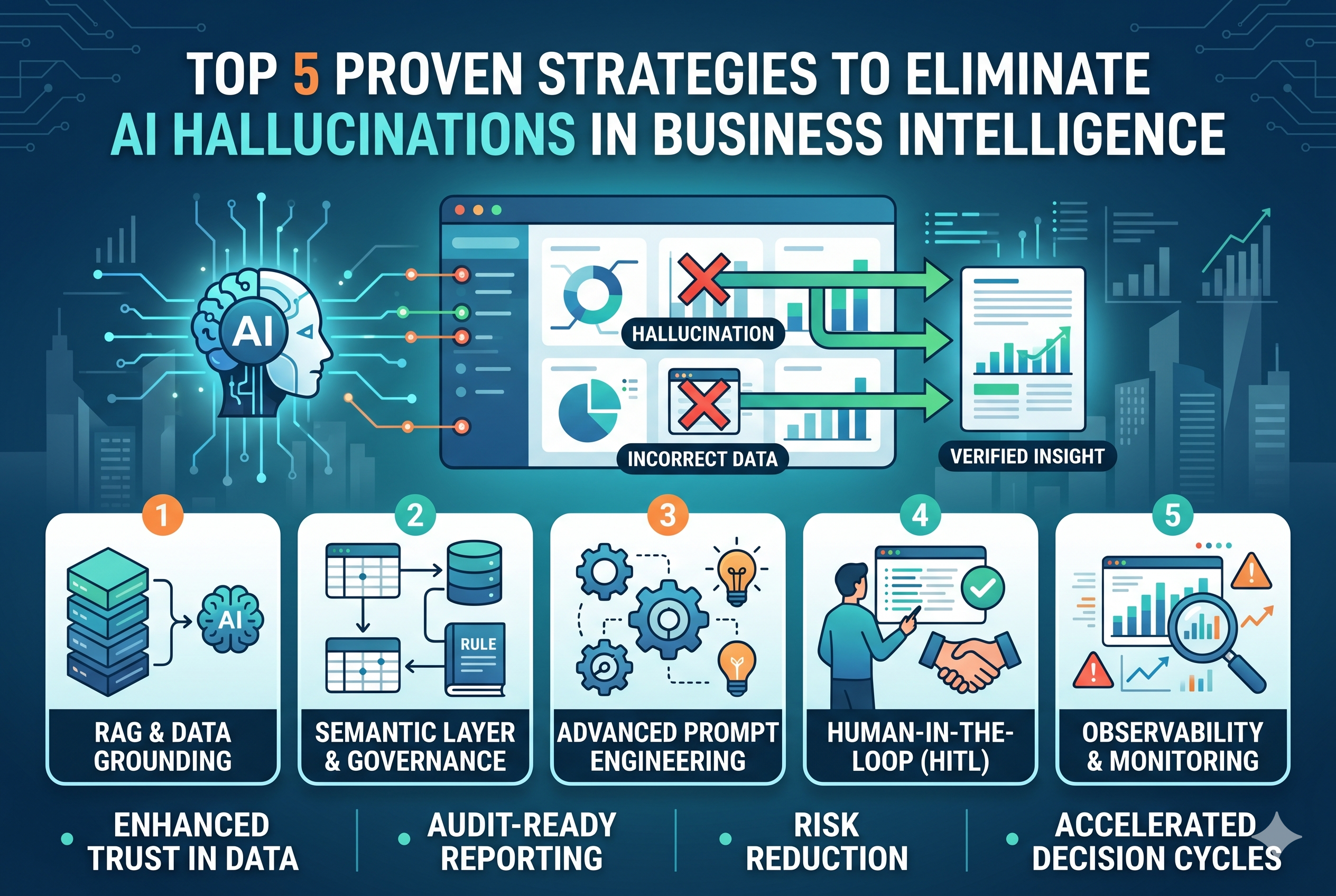
This article presents five proven, production-grade strategies to architect hallucination out of your AI-driven BI stack. Each strategy is paired with an enterprise implementation path and measurable business outcome.
What AI Hallucination Actually Means in a BI Context
When large language models like GPT-4 or Claude generate responses, they do not “look up” answers, they predict the most statistically plausible next token given a context window. Without a grounding mechanism, they can produce confident, coherent, and completely fabricated outputs. In a consumer setting, this means a wrong recipe recommendation. In an enterprise BI environment, it means a CFO receiving a margin analysis built on invented figures.
The root causes of hallucination in enterprise analytics environments are structural and predictable:
- Data fragmentation: When an AI layer is deployed across siloed data sources — CRM, ERP, data warehouse, external feeds — without a unified semantic model, the LLM interpolates across incomplete contexts and fills gaps with inference rather than fact.
- Lack of grounding: LLMs trained on general corpora have no innate awareness of your organization’s specific definitions, hierarchies, or business rules. Without retrieval-augmented access to verified data, every response is a best guess.
- Weak semantic layers: When metric definitions are inconsistent — “revenue” meaning different things in Finance, Sales, and Operations — the AI has no authoritative source to anchor its outputs against. It picks one interpretation and runs with it.
- Prompt ambiguity: Vague queries like “show me performance” give the model too much latitude. Without schema constraints and metadata injection, the output space is unbounded — and hallucination-prone.
The 5 Proven Strategies
STRATEGY 01
Retrieval-Augmented Generation (RAG) with Enterprise Data Grounding
Problem: The LLM generates metrics from training data, not live enterprise records.
Mechanism: RAG replaces probabilistic inference with fact-based retrieval. The LLM is constrained to reason over verified records, not statistical priors. Vector search + structured SQL retrieval grounds every response in authoritative data from your warehouse or lakehouse.
Implementation: Build retrieval pipelines connecting the AI layer to Snowflake, BigQuery, or Databricks. Embed enterprise schemas. Inject retrieved records as grounded context before generation. Link every AI output to a retrievable source citation.
Outcome: Traceable, source-cited, verifiable insights at every query. Zero hallucinated metrics.
STRATEGY 02
Semantic Layer + Data Governance Enforcement
Problem: Inconsistent metric definitions allow the AI to choose its own interpretation.
Mechanism: A governed metrics layer (dbt Semantic Layer, AtScale, Cube) enforces business definitions before any data reaches the AI layer. When the LLM queries for “Q3 EMEA revenue,” it receives a structured, governed response shaped by your business rules.
Implementation: Deploy a metrics catalog and data catalog (Collibra, Alation, DataHub). Map all AI queries through semantic resolution before execution. Maintain lineage, ownership, and freshness metadata.
Outcome: Consistent, audit-ready reporting with zero definitional drift across Finance, Sales, and Operations.
STRATEGY 03
Advanced Prompt Engineering + Context Injection
Problem: Generic, role-agnostic prompts leave the model unconstrained — output quality is unpredictable.
Mechanism: Schema-aware system prompts inject the relevant data schema, available tables and field definitions, business context (fiscal calendar, reporting hierarchy), role-based constraints, and explicit output format requirements. The LLM becomes a constrained reasoning engine operating within a verified information boundary.
Implementation: Build a prompt template library. Automate metadata injection via middleware orchestration. Define role-based prompt profiles for different user personas (analyst, executive, compliance officer).
Outcome: 40–60% reduction in off-target or ambiguous AI responses. Dramatically reduced hallucination surface area.
STRATEGY 04
Human-in-the-Loop (HITL) Validation Frameworks
Problem: Fully autonomous AI outputs reach executives without validation checkpoints.
Mechanism: HITL in BI means building approval workflows for high-stakes AI-generated insights. Confidence-scored outputs route below-threshold insights to human review queues. High-certainty outputs can be published; low-certainty outputs trigger domain expert escalation.
Implementation: Integrate HITL workflows into BI publishing pipelines. Define escalation thresholds by domain (finance, operations, CX). Build sign-off workflows for executive dashboard distribution. Maintain audit trails for every validated insight.
Outcome: Risk-controlled decision intelligence with a documented accountability chain at every material decision.
STRATEGY 05
AI Observability & Hallucination Monitoring Systems
Problem: AI accuracy degrades silently as data distributions shift and model behavior drifts.
Mechanism: A purpose-built observability stack for LLM outputs monitors confidence scores, flags output drift against known baselines, detects anomalous claims, and triggers alerts when AI-generated insights deviate from expected ranges. Tools like Arize AI, WhyLabs, and Langfuse provide production-grade telemetry.
Implementation: Deploy LLM observability platform. Define SLOs for AI output accuracy. Integrate with alerting and incident management. Treat AI accuracy as an ongoing operational commitment, not a launch-time checkpoint.
Outcome: Continuous, production-grade reliability with full audit trails for compliance and governance reporting.
Reference Architecture: The Hallucination-Resistant BI Stack
Each of the five strategies maps to a discrete layer in the following reference architecture. Hallucination risk is reduced systematically at every tier — no single point of failure, no single point of trust.
| DATA LAYER | Data Warehouse / Lakehouse (Snowflake, Databricks, BigQuery). Centralized, versioned, access-controlled. All AI queries execute against authoritative source records — no stale caches, no synthetic interpolation. |
| SEMANTIC LAYER | Metrics Catalog + Governance Engine. Enforces consistent business definitions before any data reaches the AI layer. Eliminates definitional ambiguity as a hallucination vector. Integrates with data lineage and access controls. |
| AI LAYER | LLM + RAG Pipeline. Retrieval-augmented generation constrains the model to verified data. Schema-aware prompt templates inject context. Role-based constraints scope the output space. The LLM reasons over facts, not priors. |
| ORCHESTRATION | HITL Workflow + Approval Engine. Routes AI-generated insights through confidence-based validation logic. High-stakes outputs require sign-off. Low-confidence responses trigger escalation. Audit trail maintained end to end. |
| OBSERVABILITY | LLM Telemetry + Anomaly Detection. Real-time monitoring of confidence scores, output patterns, and anomaly signals. SLOs for AI accuracy. Continuous reliability enforcement every day in production. |
Hallucination-Prone vs. Hallucination-Resistant BI
| Dimension | Hallucination-Prone BI | Hallucination-Resistant BI |
| Data grounding | LLM generates from training priors; no live data retrieval | RAG pipeline retrieves verified records before every response |
| Metric definitions | Inconsistent; model picks its own interpretation | Governed semantic layer enforces single source of truth |
| Prompt design | Generic, unstructured; broad output space | Schema-injected, role-aware, constrained to verified context |
| Decision validation | AI outputs distributed directly to stakeholders | HITL workflows gate high-stakes insights behind human review |
| Production monitoring | No observability; accuracy degrades silently | Real-time telemetry with confidence scoring and drift detection |
| Audit readiness | No traceability; output provenance unknown | Full lineage from query to source data, logged and timestamped |
| Trust trajectory | Erodes as errors surface and go unexplained | Compounds as consistent accuracy builds institutional confidence |
Business Impact: What Accuracy Unlocks
Beyond individual efficiency gains, the business case for hallucination-resistant BI is structural. Organizations that solve hallucination before scaling AI adoption retain the optionality to accelerate. Those that discover the problem post-scale face a far harder challenge — not just fixing the architecture, but rebuilding the trust of every stakeholder who acted on a hallucinated insight.
Why Most Enterprise AI Copilots Stall
- 3–5x faster executive decision cycles when leaders genuinely trust their AI-generated insights
- ~40% reduction in analytics rework costs when outputs are consistently accurate
- 100% audit traceability — every AI-generated insight linked to its verified source
- Measurably lower compliance risk as AI outputs gain documented provenance
- Compounding institutional confidence in AI-driven decision-making over time
“Accuracy is the product. AI is just the interface.”
The majority of enterprise AI copilot initiatives fail not at the technology layer but at the architecture layer. They are built as chatbots layered over data — impressive in demos, fragile in production. They get stuck in proof-of-concept because every attempt to scale surfaces the same fundamental problem: the outputs cannot be trusted.
The pattern is predictable. A vendor deploys a natural language query interface over a data warehouse. Initial demos perform well. Then a business user asks an edge-case question. The model hallucinates a plausible-sounding answer. A decision gets made. Someone catches the error downstream. The project stalls. The AI team defends the technology. Business leadership quietly retreats to their spreadsheets.
The enterprises that successfully scale AI-driven decision intelligence share a common characteristic: they treat accuracy as the core product requirement, not an afterthought. They invest in the semantic layer before the AI layer. They build retrieval pipelines before they build interfaces. They instrument observability before they grant production access. Book an AI Accuracy Assessment
Frequently Asked Questions
What causes AI hallucinations in BI systems specifically?
In BI environments, hallucinations typically arise from four compounding factors: the absence of live data grounding (the LLM generates from training priors, not current records), inconsistent semantic definitions across business units, overly broad prompts that fail to constrain the model’s output space, and a lack of monitoring that allows silent accuracy degradation over time.
Can hallucinations be completely eliminated?
Complete elimination is the wrong frame. The correct goal is reducing hallucination to an organizationally acceptable risk level, with full observability over what remains. RAG, governed semantic layers, and HITL frameworks can reduce material hallucination in production BI to near-zero for well-defined query domains. Edge cases will always exist — the key is instrumenting them so they are caught before they reach decisions.
How does RAG specifically improve AI accuracy in analytics?
RAG replaces the model’s reliance on statistical patterns in training data with structured retrieval from verified sources. Instead of predicting what a metric should be based on patterns in its training corpus, the model retrieves the actual value from your data warehouse, then reasons over it. This constrains the generation process to factual grounding, dramatically reducing the probability of fabricated outputs.
What role does data governance play in AI reliability?
Data governance is the upstream prerequisite for AI accuracy. Without governed metric definitions, ownership, lineage, and access controls, the AI layer has no authoritative reference to anchor its outputs against. Governance does not slow AI deployment — it is the infrastructure that makes trustworthy AI deployment possible at enterprise scale.
How can enterprises measure and monitor AI accuracy over time?
Enterprise AI accuracy monitoring requires a purpose-built observability stack: confidence scoring on every LLM output, baseline comparison against known-accurate results, anomaly detection for out-of-range claims, and output drift monitoring as data distributions evolve. Platforms like Arize AI, WhyLabs, and Langfuse provide production-grade telemetry infrastructure. Treat AI accuracy as an SLO — not a launch-time checkpoint but an ongoing operational commitment.