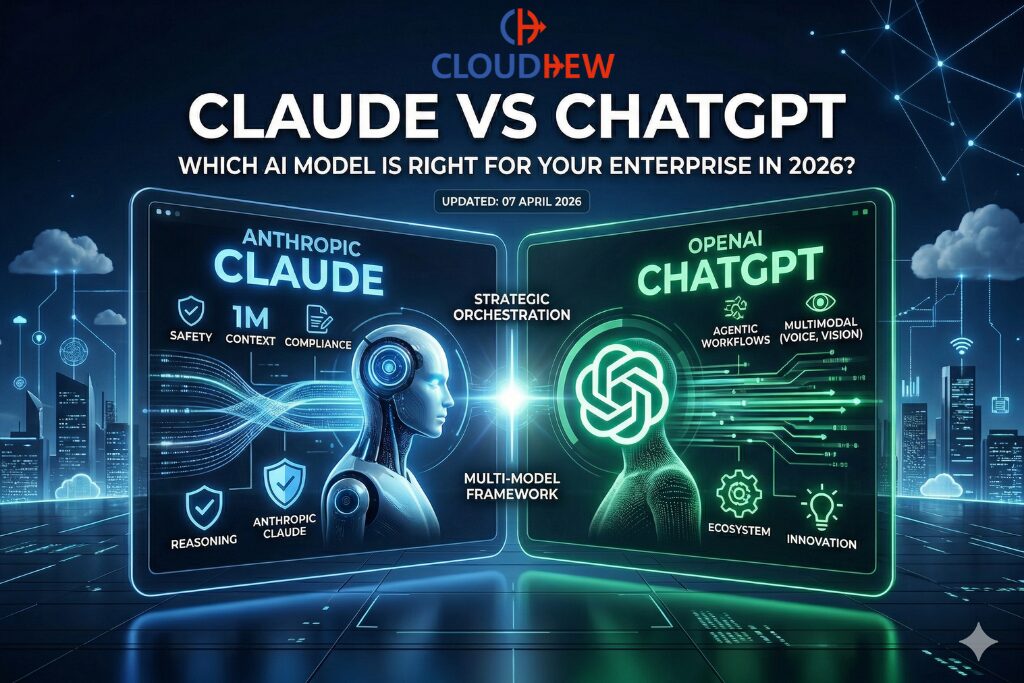

Updated: 07 April 2026 – The enterprise AI landscape is no longer about simple automation; it is about strategic orchestration. As we move through 2026, Large Language Models (LLMs) have matured from experimental chatbots into the core infrastructure of digital transformation.
Two titans lead this space: OpenAI’s ChatGPT and Anthropic’s Claude.
For a business leader, the question isn’t which model is “smarter” in a vacuum. The real challenge is determining which model aligns with your specific business outcomes, risk tolerance, and architectural readiness. This guide provides a deep-dive comparison to help you navigate the strategic divide between these two powerhouses.
The Philosophical Divide: Performance vs. Predictability
At their core, these models are built on different foundational philosophies. Understanding this is the first step in choosing the right fit for your organization.
- ChatGPT (The Innovator): Built on the GPT-4/5 architecture, it is designed for generalization and extensibility. It thrives in dynamic environments where it needs to “reason” through complex, multi-step tasks and interact with external APIs.
- Claude (The Guardian): Developed by Anthropic using Constitutional AI, Claude is designed to be “helpful, honest, and harmless.” It prioritizes safety and alignment, making it remarkably stable for regulated industries.
High-Level Capability Matrix
| Feature | ChatGPT | Claude | Enterprise Impact |
| Primary Strength | Creative Reasoning & Coding | Safety & Long Context | Determines task allocation. |
| Context Window | High (Up to 128k+) | Industry-Leading (200k+) | Critical for large document sets. |
| Multimodality | Advanced (Vision, Voice, DALL-E) | Focused (Text & Document) | Affects UX & UI possibilities. |
| Ecosystem | Massive (Microsoft/Azure) | Growing (AWS/GCP) | Dictates integration speed. |
Real-World Enterprise Performance
1. Customer Support & Real-Time Interaction
In high-velocity environments, ChatGPT remains the leader. Its response latency is typically lower, and its conversational “personality” is more adaptable to brand voices. It handles short, punchy interactions with a level of fluidity that keeps customer CSAT scores high.
2. Deep Document Intelligence & Legal Review
When your legal team needs to find a specific clause across 50 different 100-page vendor contracts, Claude is the clear winner. Its ability to maintain “coherence” over massive amounts of text—without losing the thread—reduces the risk of hallucinations in high-stakes analysis.
3. Coding & Technical Development
For software engineering teams, ChatGPT is essentially a senior-level pair programmer. Its ability to generate boilerplate code, debug complex logic, and suggest architectural improvements is currently unmatched.
4. Compliance & Risk Management
In industries like BFSI (Banking, Financial Services, and Insurance) and Healthcare, “being creative” is often a liability. Claude’s structured, cautious outputs make it easier to audit and safer to deploy in front of sensitive data.
The Technical Latency Gap: Speed vs. Depth
In the enterprise world, every millisecond counts. When deploying AI at scale, the latency profile of your chosen model becomes a critical cost and UX factor.
- ChatGPT (Turbo & 4o Models): Optimized for “Time to First Token” (TTFT). This makes ChatGPT the industry leader for real-time streaming responses. If your application requires a snappier, “human-like” typing speed, OpenAI’s infrastructure is currently tuned for this high-velocity throughput.
- Claude (Haiku, Sonnet, & Opus): Anthropic offers a tiered approach. While Claude Haiku is remarkably fast for simple tasks, the larger Opus model prioritizes “reasoning depth” over raw speed. In complex legal or medical analysis, the user expects a slight delay in exchange for a more verified, structured response.
Latency vs. Task Complexity Matrix
| Task Type | Preferred Model | Why? |
| Simple Data Extraction | Claude Haiku | Near-instant, low-cost processing. |
| Conversational Chat | ChatGPT-4o | Optimized for natural streaming and low TTFT. |
| Complex Logic/Coding | ChatGPT-4 / 5 | High-speed iterative reasoning. |
| Deep Narrative Review | Claude Sonnet | Balanced speed with long-context coherence. |
The Economic View: Total Cost of Ownership (TCO)
Choosing a model isn’t just about the API price per 1,000 tokens. It’s about the total cost of accuracy.
| Cost Factor | ChatGPT | Claude | CloudHew Recommendation |
| API Pricing | Competitive / Tiered | Competitive for Long-Form | Use ChatGPT for high-volume chat. |
| Fine-Tuning | Highly Accessible | Limited / Controlled | Use ChatGPT for custom “brand” voices. |
| Governance Cost | Higher (Needs external filters) | Lower (Safety is built-in) | Use Claude for regulated workflows. |
| Latency Cost | Low (Fast execution) | Moderate (Thorough processing) | Use ChatGPT for real-time apps. |
Strategic Use Case Mapping
| Business Function | Recommended Model | Primary Reason |
| Sales & Marketing Content | ChatGPT | Creativity and multi-channel adaptation. |
| Legal Discovery & Research | Claude | Massive context window and accuracy. |
| Product Engineering (Code) | ChatGPT | Robust debugging and library knowledge. |
| Compliance & HR Policy | Claude | Reduced hallucination and safer outputs. |
| Customer Support Bots | ChatGPT | Speed of response and integration. |
| Financial Risk Modeling | Claude | Predictability and structured reasoning. |
Enterprise Security: Data Sovereignty and Governance
The Microsoft-OpenAI Nexus
For organizations heavily invested in the Microsoft 365 ecosystem, Azure OpenAI provides a “walled garden.” Your data never leaves the Azure compliance boundary, inheriting the same security protocols as your Outlook or SharePoint files. This makes ChatGPT the default choice for companies requiring SOC2 Type II and HIPAA compliance.
The Anthropic-AWS-Google Alliance
Claude has positioned itself as “platform-agnostic.” By partnering with AWS (Bedrock) and Google Cloud (Vertex AI), Anthropic allows enterprises to run Claude models within their own VPC (Virtual Private Cloud). This is a game-changer for organizations that refuse to send data to a third-party API.
The Road to Multi-Model Maturity: A CloudHew Framework
At CloudHew, we advise our clients that the “winner” of the AI wars will fluctuate. Therefore, your strategy should be built on a Model-Agnostic Framework.
- The Abstraction Layer: Don’t hard-code your applications to a specific API. Use an abstraction layer that allows you to swap models without rewriting your codebase.
- Dynamic Routing: Implement logic that routes tasks based on cost and context. If a query is <50 words, route to ChatGPT; if it includes a massive PDF, route to Claude.
- Continuous Benchmarking: AI performance degrades or improves with every update. CloudHew provides automated benchmarking to ensure you are always getting the highest ROI.
Comparative Enterprise Roadmap
| Phase | ChatGPT Strategy | Claude Strategy |
| Adoption (Months 1-3) | Roll out “Copilots” for productivity. | Start massive document digitization. |
| Integration (Months 4-9) | Connect to CRM/ERP for automation. | Integrate into Legal/Compliance review. |
| Optimization (Month 12+) | High-scale external customer agents. | Use as “Truth Layer” to validate AI outputs. |
Final Decision Matrix for 2026
| Goal | Choose ChatGPT If… | Choose Claude If… |
| Speed to Market | You need extensive APIs and plugins. | You need a standalone, safe tool. |
| Data Complexity | Your data is short but varied. | Your data is long and technical. |
| User Experience | You want a “human-like” chat flow. | You want a “fact-like” report flow. |
| Security | You are on the Microsoft stack. | You prefer AWS or GCP infrastructure. |
Conclusion: Outcome Over Hype
Claude and ChatGPT are both powerful, but they serve different masters. ChatGPT drives your innovation and speed; Claude ensures your safety and depth.
The real competitive advantage for your enterprise lies in how you orchestrate them together. By building a multi-model foundation, you ensure that your business stays agile as the AI landscape continues to shift.
FAQs
1. Frequently Asked Questions: The Enterprise Perspective
1. How do ChatGPT and Claude handle data privacy for enterprise users?
Both OpenAI and Anthropic offer dedicated enterprise tiers (ChatGPT Enterprise and Claude Enterprise) that guarantee your data is not used for model training.
- ChatGPT: Leverages the Azure OpenAI infrastructure for those who need data to stay within the Microsoft compliance boundary (SOC2, HIPAA).
- Claude: Offers VPC (Virtual Private Cloud) deployment options through AWS Bedrock and Google Vertex AI, allowing organizations to keep all AI processing within their own secure cloud perimeter.
2. Which model is better for a massive codebase or 500+ page documents?
Claude is the clear winner for long-context tasks. With a context window of up to 1 million tokens in its 2026 flagship models (Claude 4.6), it can “read” and maintain coherence over an entire library of code or thousands of pages of documentation in a single prompt. While ChatGPT has increased its capacity, Claude consistently scores higher on “needle-in-a-haystack” retrieval tests for very large datasets.
3. Can I use both models simultaneously in my business?
Yes, and we recommend it. Many organizations use an “Orchestration Layer” to route tasks. For example, you might use ChatGPT for its superior web-browsing and image generation capabilities (DALL-E 3/4) to support marketing, while routing complex legal or technical analysis to Claude for its safety-first reasoning and document depth.
4. Which AI is superior for software development and DevOps?
As of 2026, Claude has taken a slight lead in functional coding accuracy (approximately 95%) and is often preferred by developers for refactoring and understanding multi-file codebases. However, ChatGPT remains more deeply integrated with the GitHub Copilot ecosystem and is generally faster for generating quick snippets and boilerplate code.
5. Does Claude support voice or image generation like ChatGPT?
No. ChatGPT is a truly multimodal “omni” model, supporting native real-time voice conversations and advanced image/video generation. Claude remains focused on text and document intelligence. If your enterprise requires AI for creative asset generation or voice-based customer service, ChatGPT is the necessary choice.
6. How do I avoid “Vendor Lock-in” with OpenAI or Anthropic?
The best way to avoid lock-in is to build a Model-Agnostic Architecture. This involves using an abstraction layer (like LangChain or a custom CloudHew API gateway) that allows you to switch your backend from ChatGPT to Claude (or vice versa) without rewriting your entire application. This keeps you agile as model performance and pricing shift.
7. Is there a difference in how they handle “hallucinations”?
Claude is generally more “honest” and cautious. Because it is built on Constitutional AI, it is programmed to admit when it doesn’t know an answer rather than guessing. ChatGPT is more “creative” and proactive, which is great for brainstorming but may require more rigorous human-in-the-loop validation for factual reporting.
8. Which model is more cost-effective for high-volume tasks?
For high-frequency, simple tasks (like basic categorization or short replies), ChatGPT’s “mini” or “nano” models are often the most price-competitive. For high-complexity, high-value tasks (like analyzing a global regulatory update), Claude’s middle tier (Sonnet) often provides the best balance of intelligence and cost-efficiency.